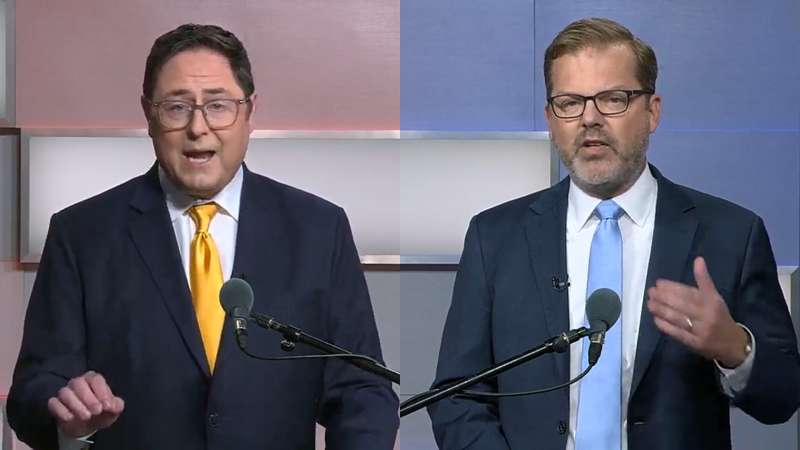
Candidates for Nebraska’s 1st Congressional District took the debate stage Wednesday, Sept. 24, contrasting their positions on a number of topics likely to be top of mind for voters hitting the polls on Nov. 3.
The debate, co-hosted by Nebraska Public Media and the Omaha World-Herald, was the first between incumbent Republican Mike Flood and his Democratic challenger Chris Backemeyer—a former senior State Department official making his first run for elected office.
The match-up overcame some scheduling drama to occur. Over the one-hour live event, Flood and Backemeyer detailed their resumes and answered a total of 14 questions from the moderators, ranging from foreign policy to artificial intelligence to agriculture.
Here were three key themes from the NE-01 debate.
Iran
Nearly seven months since the US-Israel war with Iran began, it was the first issue addressed in the debate. Describing his past experience in Iran-related diplomacy, Backemeyer cited his work developing the Iran nuclear deal—an agreement to limit the Iranian nuclear program in return for sanctions relief and other provisions—as an edge over Flood.
Backemeyer said the deal “would have also prevented the war that we’re in today, had it not been torn up for partisan political purposes,” referring to President Donald Trump’s withdrawal from the agreement in 2018.
The former diplomat criticized the war effort for an apparent lack of strategy, its impact on the economy, and Flood for voting against resolutions to stem US involvement in the conflict six different times since it started.
When asked about the war’s ballooning effect on costs for fertilizer and diesel fuel, and how Congress ought to assist ag producers, Flood floated the idea of reexamining export bans and taxes on fuel, but ultimately said he supports the president’s war effort.
“I want it over as fast as everybody else,” Flood said. “But I’m not willing to cut and run until the job is done.”
“I’m no pacifist,” Backemeyer responded to the question. “I believe in using military force when necessary… But our representative should be asking the hard questions about our strategy. What are we trying to accomplish? What are our objectives? How are we going to achieve those? And then how are we going to get out?”
Flood also criticized President Joe Biden’s withdrawal of US troops from Afghanistan in 2021. The administration adhered to the inherited exit timeline from the 2020 Trump-Taliban Doha Agreement.
Backemeyer said the war and its economic impacts are top concerns among NE-01 voters. The subject was discussed several more times over the debate, especially in regards to affordability.
Big Beautiful Bill
In July 2025, Flood joined House Republicans in voting for Trump’s second term landmark tax and spending package H.R. 1—often called the “Big Beautiful Bill.” The sweeping legislation’s effects served as the basis for several questions during the debate.
Backemeyer hit Flood over his vote when asked about resident opposition to data centers, noting provisions in the bill that gave tax breaks to big tech companies for research and development investments, equipment purchases, and factory construction.
“If our communities want these data centers, they should have them, but they should be the ones making that decision,” said Backemeyer. “They should be deciding if they want to give tax breaks. they should be getting the benefits from the tech companies, not the other way around.”
Flood said he agreed with Backemeyer that data center projects should be coupled with public benefit agreements, adding that natural resources “need to be protected” and municipal governments should have the final say.
Candidates were also asked about the slated $1 trillion in Medicaid cuts over the next decade outlined in the bill, and the attempt to offset those cuts through the Rural Health Transformation Fund—which is projected to annually infuse $218 million for five years into Nebraska’s healthcare system.
State hospital officials have expressed skepticism that the funds will be sufficient to keep healthcare options afloat in rural areas, especially when compared to the financial lifeline created by Medicaid.
Flood listed a number of facilities and services in NE-01 he believes those funds will help safeguard, while adding “there’s work to be done there.”
Backemeyer called the cuts “callous” and “heartless,” speaking anecdotally about a Norfolk dentist who hadn’t seen financial assistance from the fund yet and the mother of a son with disabilities whose coverage was impacted due to new work requirements.
In rebuttal, Flood repeated his past defense of the cuts, saying to undocumented immigrants and unemployed able-bodied people: “You don’t get free healthcare.”
Countering, Backemeyer called Flood’s response “out of touch” with “people that are actually getting Medicaid.”
“They’re not all sitting in their parents’ basement playing video games,” he said. “They are people struggling to get ahead or to make a living with these work requirements. For example, they are required to work more hours than Congress did this very session in the 104 days that they were in… I’m far more concerned about the 50-year-old who gets $175,000 a year to represent Nebraskans and then doesn’t even read the bill before he cuts the same benefits to people who need them.”
“For the record, I am 51,” Flood quipped back.
ICE
The 1st district candidates also sparred over their differences on immigration enforcement, as Nebraska saw a 329% increase in arrests by by Immigration and Customs Enforcement (ICE) from 2024 to 2025, when Trump’s second term began. Flood and Backemeyer were asked about this statistic and the best path forward to increase the number of skilled workers and address labor shortages.
Backemeyer, acknowledging his history working under Republican and Democratic administrations, said the US needs a “strong” southern and northern border, where it’s known who crosses and why. He also called for “comprehensive immigration reform” to make a legal pathway to citizenship more accessible.
“What we’ve seen from this administration has been lawlessness by ICE,” Backemeyer said. ”We’ve had women and children, children dragged out of their homes, people shot, American citizens shot in the street and people deported without cause.”
Flood largely defended the Trump administration’s immigration approach, calling it the “most secure border that we’ve had in 50 years.”
“I support ICE and CBP doing their job,” Flood said, adding that the murders of two Minnesota activists—Renée Nicole Good and Alex Pretti—made him “sick” to his stomach. Flood praised Trump’s decision to “pivot” from former Department of Homeland Security Secretary Kristi Noem to White House Border Czar Tom Homan.
“I’m glad we’re on a much better path today,” Flood added.
“ICE currently has a bigger budget than the US Marine Corps… Does that make sense?” Backemeyer shot back. “ICE has a bigger budget than all of our federal law enforcement agencies combined. That doesn’t make sense.”
ICE doesn’t need to be abolished, according to Backemeyer, but Congress needs to “rein it in and return to its mission post 9/11,” when ICE mainly focused on counterterrorism and cross-border criminal activity.
Closing remarks
Each candidate was given two minutes for closing statements.
Flood told viewers their one takeaway from the debate ought to be: “I’ve built my life here. I listen and I get results. I know what values the community has. Work hard. Look after your neighbors and do what you say you’re going to do. I listen to the communities in this district and then I act on it.”
Backemeyer, on the other hand, underlined his background working in different administrations, pitching himself as a bipartisan problem solver who can reach across the aisle.
“But I would ask a question to everybody out there,” Backemeyer posed, “How do you feel? Are you happy with the direction of our country and our state? Do you feel good about the way things are going? If so, Congressman Flood is your guy because a vote for him is a vote for two more years of the same, tariffs and high prices, healthcare cuts and billionaire tax cuts, war, and two more years of a weak and obedient Congress that will rubber stamp anything it is asked to do.”
NE-01—which encompasses a large eastern portion of the state, minus the bulk of Omaha, but including cities like Lincoln, Bellevue, Fremont, and Norfolk—is considered a “Solid Republican” district by the Cook Political Report, which gives Flood an estimated advantage of six points this fall. However, the district was named a “district in play” by the Democratic Congressional Campaign Committee (DCCC), the official campaign arm of House Democrats.
The two candidates shook hands following the debate.
The general election is Nov. 3.