A glance at the winners of Nov. 3’s midterm election would suggest Nebraska, the nation’s ruby-red triple-landlocked state, may be the last bastion for Republican candidates in the country.
While similarly conservative states like Iowa, Kansas, and Texas saw historic “blue wave” flips in races for governor and Congress, voters in Nebraska reelected Republicans to nearly every statewide and federal office.
At a state GOP press conference following the election, US Sen. Deb Fischer, who was not up for reelection, said Nebraska “held the line.”
During a post-election press conference laying out his 2027 legislative priorities, reelected Gov. Jim Pillen gestured to a map purporting to show that voters shifted left in 94% of counties nationwide in 2026, with Nebraska largely remaining red—suggesting that most of the state’s counties “moved toward GOP.”
“Everybody seeing that? Etch that baby in your mind,” Pillen told reporters in the room. “The people in Nebraska spoke.”
Pillen’s citation of the map prompted a response from Jane Kleeb, the chair of the Nebraska Democratic Party, who called the map’s findings “FALSE.”
“By all major accounts, Nebraska shifted toward Democrats,” the party said in a statement. “Yet, our state Republicans continue to lie and spread misinformation about them losing ground.”
Kleeb was also quick to point out the map’s source, online news aggregator Ground News, lists Joe Ricketts—father of reelected Republican US Sen. Pete Ricketts—as one of its main investors.
The Omaha TV station WOWT fact-checked Pillen, citing voter data from the AP which presented a very different picture: Nebraska voters shifted left in 2026.
This Courier Nebraska review of voter data looks into these claims and aims to provide a clear and simple picture of relevant statewide voting trends in 2026.
Brick wall?
The Ground News map does not break down its findings, but cites data from civicAPI and qualifies the color gradation as “how each county’s margin moved from the 2024 presidential vote to the 2026 House vote.”
Spelled out: The map claims to show the percentage point swing from the 2024 votes for president to the 2026 votes for competing Republican and Democratic candidates for the US House.
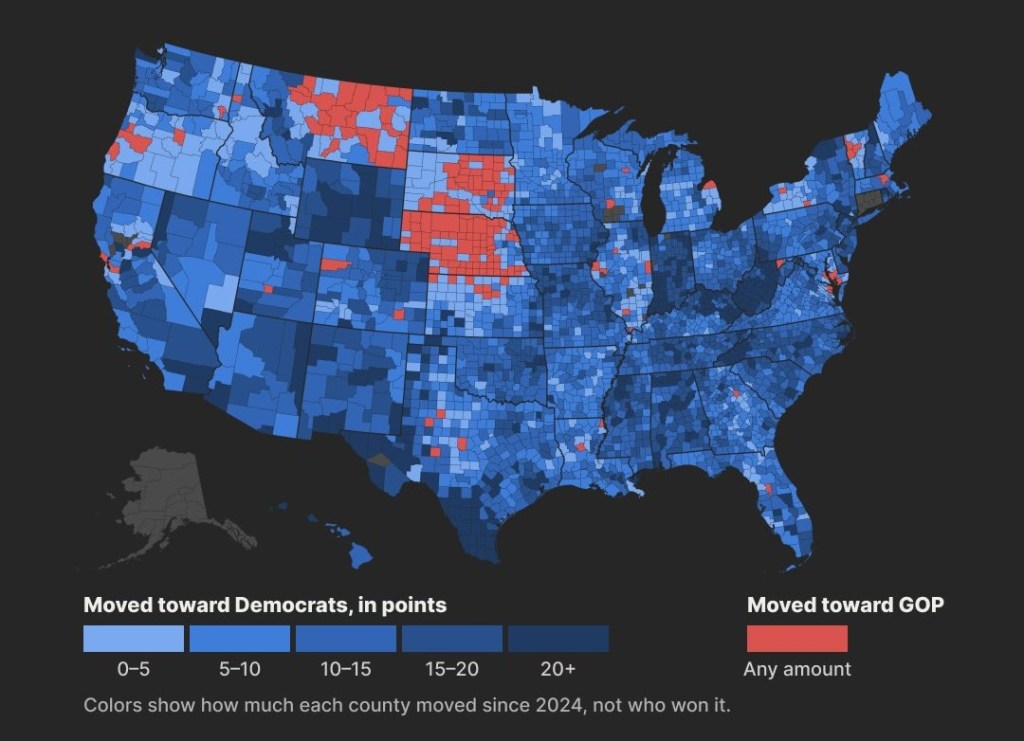
The map indicates that 29 Nebraska counties shifted left in the midterm election. In the state’s 64 remaining counties, the map claims that Republican US House candidates in 2026 improved their victory margin over Donald Trump in 2024.
But a closer review of the voter data from the official 2024 results and unofficial 2026 results shows GOP House candidates improved their margin over Trump in only 23 counties: Boone, Boyd, Brown, Clay, Cuming, Deuel, Fillmore, Franklin, Frontier, Gage, Gosper, Grant, Harlan, Jefferson, Johnson, Kearney, Keya Paha, Nemaha, *Polk, Thomas, Valley, Wheeler, and York.
*Polk County splits between Nebraska’s 1st and 3rd congressional districts. In 2026, Polk county voters swung towards NE-03 Rep. Adrian Smith (R) by about 2.6% and away from NE-01 Rep. Mike Flood (R) by roughly 8.9%—for an average overall swing of 0.2% towards Democrats—when compared to Trump’s vote margin in 2024.
Some viewers of the Ground News breakdown questioned whether the map, which showed South Dakota and Montana also moving towards the GOP, arrived at this conclusion due to US Senate candidates in those states running as registered Independents (Nebraska’s being Dan Osborn). But the map specifically notes the usage of 2026 US House race data, not US Senate race data.
Cross-referenced with data from the Nebraska Secretary of State’s office, the Ground News map inaccurately portrays 41 counties as swinging towards GOP House candidates in 2026 when compared to Trump’s 2024 performance.
In actuality, voters swung towards Democrats in those 41 counties. See a corrected map below, using the same metric stated by the Ground News map.
A more accurate comparison
Whether the 2024 presidential vote to the 2026 US House vote is a true apples-to-apples comparison is another question. One key difference is the 2024 election featured a high profile presidential race and lacked a race for governor and other statewide constitutional offices. Nebraskans last voted for governor in 2022.
Additional maps began to circulate on social media following the Nov. 3 election, perhaps in response to the Ground News map. One widely-shared post on Facebook by “Raising Nebraskans,” an Omaha-based account created on Nov. 5, 2026, claimed to have crunched the numbers which showed voters shift nearly 15 percentage points left in the 2026 governor’s race when compared to 2022.
An independent Courier Nebraska review of 2022 and 2026 voter data is consistent with the governor’s race map shared by Raising Nebraskans. See a Courier Nebraska recreation below.
In 2022, Republican Jim Pillen scored a 23-point win over Democrat Carol Blood for governor (59.9 to 36.1%).
In 2026, Pillen’s lead shrunk to under 9 points and Democrat Lynne Walz gained 14.7 points statewide (50.4 to 42.5%).
The Raising Nebraskans map also accurately notes that 86 of 93 counties swung left for governor in 2026, with Sarpy County flipping entirely. Pillen last won Sarpy by 15 points, while Walz won it this year by 2 points.
The most dramatic countywide swings towards Walz were seen in Dakota (+35%), Thurston (+30%), Colfax (+30%), Dodge (+27%), and Dawson (+25%).
The top five counties where Pillen increased his win-margin include Wheeler (+15%), Keya Paha (+8%), McPherson (+7%), Sheridan (+3%), and Hooker (+2%).
Compared to Blood’s 2022 gubernatorial bid, Walz widened her win margin in Democrats’ best performing counties: Douglas (+16%) and Lancaster (+13%).
An accurate comparison in other statewide constitutional office races from 2022 to 2026 is unachievable, as Nebraska Democrats did not run candidates for Attorney General, Secretary of State, State Auditor, or State Treasurer in 2022.
Congressional district breakdown
Nebraska voters also swung left in every single county this year for US House candidates when comparing their performance in 2024 to 2026.
This year in Nebraska’s 1st Congressional District, voters moved 16.7% towards Democrat Chris Backemeyer.
Incumbent Republican Mike Flood won the seat in 2024 by 20 points. In 2026, Flood won by only 3.5 points.
The most dramatic countywide swings were seen in Colfax (+24.7%), Lancaster (+17.4%), Dodge and Sarpy (both +16.5%), with Lancaster and Sarpy counties flipping entirely from Republican to Democrat. The smallest swing was in Stanton County (+9.9%).
Reacting to the state’s election results, Kleeb wrote on social media that “the road map is clear for NE-01 in 2028.”
See the NE-01 margin swing breakdown by county below.
In Nebraska’s 2nd Congressional District, voters moved 17.7% towards Democrat Denise Powell, who ultimately flipped the open seat, beating Republican Brinker Harding to succeed retiring Republican Rep. Don Bacon.
Bacon won the seat in 2024 by 1.8 points, defeating Democrat Tony Vargas. In 2026, Powell won by 15.9 points.
Each of the district’s three counties swung over 15 points towards the Democratic candidate, with the largest swing in Sarpy (+21.8%) and the smallest in Saunders (+15.2%). Powell won Douglas County this year by 17.4 points, more than quadrupling Vargas’ 2022 win margin in the county of 3.8 points.
Powell is the first Democrat to win the seat since Brad Ashford in 2014.
See the NE-02 margin swing breakdown by county below.
In Nebraska’s 3rd Congressional District, voters moved 9.8% towards Democrat Becky Stille.
Incumbent Republican Adrian Smith, who was first elected to the seat in 2006, was reelected in 2024 by nearly 61 points. In 2026, Smith lost ground, winning by 51 points.
The most dramatic countywide swings were seen in Dakota (+19.6%), Wayne (+14.9%), Dawson (+13.9%), Hall (+13.9%), and Otoe (+13.4%). The smallest swing was in Grant County (+0.3%).
While no county in NE-03 flipped entirely from Republican to Democrat in 2026, Dakota and Thurston counties came the closest—Smith won the former by 530 votes and the latter by just 95 votes.
See the NE-03 margin swing breakdown by county below.
Statewide turnout
Another telling trend when comparing the 2024 and 2026 elections is a large decline in voter turnout.
Typically, voters are less eager to hit the polls during midterm elections than presidential election years. While Nebraska voter turnout in 2026 was historically high for a midterm election, it lagged behind 2024.
According to unofficial 2026 canvassing numbers from the Secretary of State’s office, 61.33% of eligible Nebraska voters hit the polls this year—775,942 out of 1,265,162.
In 2024, 76% of eligible Nebraska voters hit the polls—965,236 out of 1,263,487.
During a midterm rally stop in Grand Island in October, President Trump told the crowd “I’m going to ask you to pretend that I’m running.”
“When I’m on the ballot, people show up and you always win,” Trump said. “When I’m not on the ballot, 45% fewer people show up. So I’m asking you to do me one favor. Please. We got to go and win this.”
What do the numbers really show?
While Pillen and Fischer are correct in saying Republican candidates in Nebraska “held the line” and secured reelection during a “blue wave” year, the reality is that the state GOP’s current candidates faced some of their closest challengers to date.
The national wave failed to pull Republicans in Nebraska under, but floated state Democrats much closer to the surface than the GOP would prefer.
But Democrats do have wins to celebrate in 2026, most notably Powell’s win in NE-02. The party also successfully flipped enough seats in the state Legislature to break the Republican supermajority, and ran successful candidates in races for county attorney and sheriff in Douglas and Lancaster.
“I often kind of joke that Nebraska is six years behind national trends,” Kleeb told Nebraska Public Media after the election. “We are behind the national trend.”