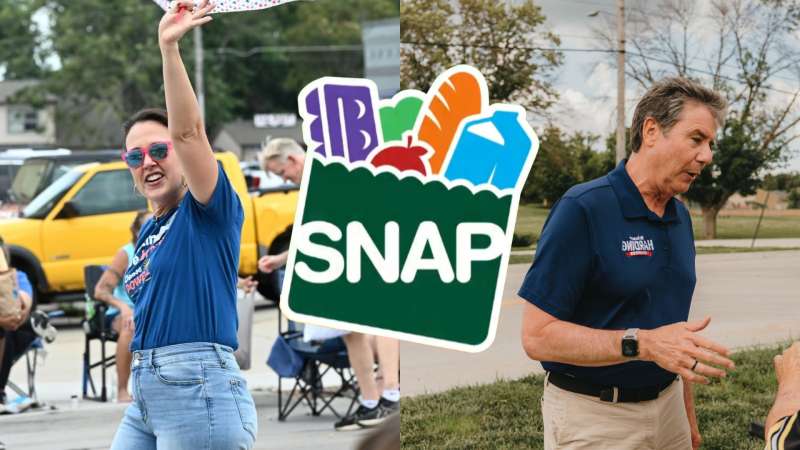
As early midterm voting begins, one issue is top of mind for tens of thousands of Nebraskans: hunger. It’s shaping up as a dividing line in Nebraska’s “Blue Dot” congressional race between Brinker Harding and Denise Powell.
In the last year, 40,000 residents in the state have lost access to the federally funded Supplemental Nutrition Assistance Program (SNAP). The figure represents a 26% culling in total enrollees—from 149,527 in August 2025 to 109,684 in August 2026, according to the latest data released by the Nebraska Department of Health and Human Services.
This precipitous decline corresponds with cuts to SNAP laid out in H.R. 1, known as the One Big Beautiful Bill—the signature tax and spending bill of President Donald Trump’s second term signed into law on July 4, 2025 following enthusiastic, nearly universal backing from Republicans in Congress. The bill is projected to axe about $187 billion from the program through 2034, according to the nonpartisan Congressional Budget Office.
It’s the largest cut to SNAP in its history. It mainly does this by shifting costs to states and instituting new eligibility and work requirements.
Nebraska was a test case for how the cuts would play out in practice, being one of the first states to implement the expanded SNAP guidelines on Oct. 20, 2025. These rules expanded work requirements to adults aged 18–64, stripped previous exemptions for veterans and unhoused individuals, and barred refugees and asylees from eligibility.
‘Shock and horror’
The financial shift, in large part, begins today.
Effective Oct. 1, 2026, H.R. 1 reduced the federal government’s share of administrative costs from 50% to 25%. States are now on the hook for the remaining 75% of the administrative burden.
During a panel discussion hosted Wednesday with Nebraska For Us, a nonprofit focused on economic policy impacts, advocates warned that the new paperwork hurdles have caused people who were otherwise eligible to lose benefits.
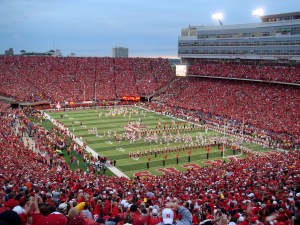
“My reaction is shock and horror at these numbers,” said Eric Savaiano, Food and Nutrition Access Program Manager at Nebraska Appleseed. “It’s a little less than half of Memorial Stadium filled up. It’s a little more than the entire city of Kearney. We see the slope going down with no end in sight.”
Half of those losing coverage are children ages 0 to 18, Savaiano said, adding that kids losing SNAP are no longer automatically able to receive free or reduced-price school meals. Schools generally wish to expand access to these meal programs in order to receive federal funding.
As federal support drops, food banks are stressed by the growing demand to fill the gap.
How could it play into the midterms?
H.R.1 received unanimous support from Nebraska’s all Republican congressional delegation. The three seeking reelection this fall—Rep. Mike Flood (NE-01), Adrian Smith (NE-03), and US Sen. Pete Ricketts—continue to defend their vote and its changes to SNAP on the campaign trail.
But nowhere are the cuts more politically loaded than in the Omaha-based 2nd District where Brinker Harding, where the Republican nominee to replace retiring Rep. Don Bacon has embraced the law that made them, while Denise Powell, his Democratic opponent, has made reversing its consequences central to her campaign.
While district-by-district breakdowns for SNAP enrollment are not published directly, NE-02 encompasses all of Douglas County, Saunders County, and portions of Sarpy County.
According to Pantry Path, as of April 2026, 9.2% of households in Douglas County, 4.4% in Saunders, and 5.1% in Sarpy are on SNAP. With Douglas being the state’s most densely populated county, the congressional district may have the highest quantity of SNAP households in the state.
In a candidate survey, when asked about SNAP, Harding said Congress’s job was to “protect those programs for those who truly need them.”
“The goal should be a bridge to self-sufficiency, not a permanent substitute for it,” Harding said.
But on the day Trump signed H.R. 1 into law, the Omaha City Councilman posted on social media saying: “Two of my campaign pillars are Grow America and Secure America. The One Big Beautiful Bill does just that.”
Powell has also been a vocal opponent to the austerity measures in H.R. 1. In the same survey, she called the SNAP cuts “cruel” and said Congress should fully fund these programs to help the most vulnerable families.
“I will always protect programs like SNAP and WIC – particularly for kids and seniors,” she said.
The founder of Women Who Run, which is focused on preparing female candidates for office, told the Omaha World-Herald that she hosted a food drive in Nov. 2025 in response to the increased demand.
Affordability concerns
The topic closely intersects with what pollsters find to be the single most prevalent issue for voters this November: affordability.
According to a Pew Research Center survey, most voters want to hear congressional candidates talk about economic issues, specifically prices and affordability, on the campaign trail.
78% of voters have a favorable opinion of SNAP, according to a 2025 survey from Data for Progress.
Nebraskans in the 2nd district and beyond will make their voices heard in the general election on Nov. 3.