While the US-Israel-led Iran war rattles the US economy with little public support, Nebraska Republicans are supporting the war’s continuation while pitching “affordability” to voters in November—with remedies that sidestep the conflict driving costs.
The lockstep backing from the NEGOP’s congressional slate comes as Republican lawmakers and candidates nationwide increasingly break from President Donald Trump over the conflict, citing reelection concerns driven by rising prices and a lack of strategy.
The Iran war’s price tag topped $38 billion in its first five months, an average of $246 million per day, according to a new report from the Congressional Budget Office. The analysis also estimates continued costs at $3 billion per month while inflation metrics are expected to rise 0.5% by early 2027.
The cost mainly accounts for spent missiles and other munitions. The key inflationary driver is reduced natural gas shipments through the Strait of Hormuz and trade disruptions in the Red Sea, the report says. Inflation expectations have driven both short- and long-term interest rates upward, too.
While inflation stings consumers at the gas pump and grocery store, and financial markets tremor, Nebraska’s Republican office seekers hope voters accept their alternative solutions to rising costs and justification for hostilities.
NE-02
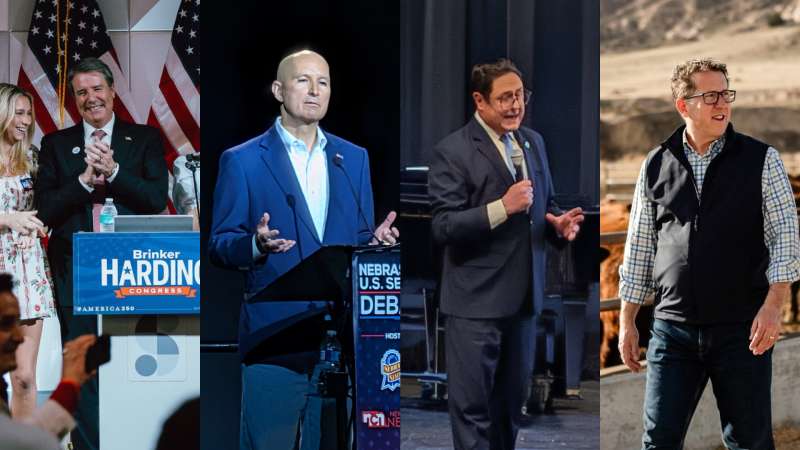
In Nebraska’s highly watched 2nd Congressional District race, dubbed the “Blue Dot” for its history voting for Democratic presidential candidates, Republican Brinker Harding has made “affordability” one of his campaign’s major prongs, and within that, checking inflation.
Asked directly if he supported the war this week on News Nation, Harding said: “What I do support is making sure that Iran never has a nuclear weapon. But first and foremost, look, we need to make sure that we get a quicker resolution to the Iran war. And we need to make sure that Iran never has a nuclear weapon or controls the Strait of Hormuz.”
On his affordability pitch, Harding said Congress can help control inflation by growing wages, listing this as one of his “concentrations” as an Omaha City Council member. When asked how to achieve this, Harding said we need an “environment conducive for that economic boom” created by “safe streets.”
The west Omaha representative voted against an ordinance in July to increase the city-wide minimum wage, saying Omaha lacked the authority.
Harding spoke of the war in necessary terms to the Omaha World-Herald in early August, saying “If you think gas prices are high today, think of what they’re going to be if Iran had a nuclear weapon and controlled the Strait of Hormuz.”
In Omaha, the core of NE-02, the average price of regular unleaded gasoline has jumped about 55% over the past year, and diesel fuel prices by 84%, according to AAA. Prices in Omaha are trending above statewide averages (Regular Unleaded +49%, Diesel +82%).
According to personal finance disclosures, Harding’s spouse owns a stake in the oil giant Exxon Mobil and Lockheed Martin Corporation, the world’s largest defense contractor, through a Schwab Brokerage Account.
Harding’s opponent, Democrat Denise Powell, has called the Iran war “unnecessary” and criticized the effort for spiking gas prices and its humanitarian toll.
“We deserve better,” Powell said in a late August social media post, reacting to Trump forecasting the war’s end by mid-September.
US Senate
Incumbent Republican Pete Ricketts has worked to soften his aristocratic image as he faces a working-class challenger in Independent candidate Dan Osborn this year.
Ricketts told WJAG in November 2025 that, if elected for a full six-year term in 2026, one of his priorities will be “affordability.” As evidence, he cited the ROAD to Housing Act, which passed with bipartisan support and without the president’s signature. Policy analysts say full implementation and economic relief of the bill will likely take several years to materialize.
During his debate with Osborn earlier this month, Ricketts said he supported continued military action in Iran and suggested a ramp up in domestic fossil fuel production to counteract market disruptions, adding there’s “no doubt” the Iran war is putting “pressure on Nebraska families.”
On Sept. 24, Ricketts voted against a resolution to block Trump from ordering further strikes on Iran.
Osborn has consistently spoken out against the war, often recalling his own passage through the Strait of Hormuz during his service in the US Navy.
“We are 185 days into a new foreign war. And Nebraskans are paying the price,” Osborn said during the debate. “We’re paying for it in our lives… We have to stop digging this hole. We have to give Congress back the power to act as a co-equal branch of government because only Congress can declare war.”
NE-01
As Nebraska’s 1st district incumbent Rep. Mike Flood attempts to ward off a Democratic challenger this year in former diplomat Chris Backemeyer, he has staunchly defended the Iran war while admitting affordability concerns.
Flood was asked about the war’s ballooning effect on costs for fertilizer and diesel fuel this week during a televised debate with Backemeyer. Flood floated the idea of reexamining export bans and taxes on fuel as solutions, but ultimately said he supports the president’s war effort.
“I want it over as fast as everybody else,” Flood said. “But I’m not willing to cut and run until the job is done.”
Backemeyer criticized Flood during the debate for his past votes on the conflict, including four separate votes against measures to direct the president to withdraw forces from Iran or win congressional approval to continue military operations there.
Flood’s position during the debate is consistent with statements he made this summer at a town hall in Bellevue, telling the crowd: “We are cleaning up the Middle East,” when asked about receiving financial support from AIPAC.
During an August interview with Bloomberg Television, Flood said he’s campaigning on affordability and focusing on “bringing down prices,” also citing the ROAD to Housing Act as a key prescription.
NE-03
Longtime Rep. Adrian Smith, first elected to represent the state’s vast 3rd district 20 years ago, is seeking another term in office in 2026.
Smith has consistently backed Trump’s war effort in Iran. In July, he told KETV: “The Trump Administration’s peace through strength approach brought Iran to the negotiating table, and I will continue to encourage them to keep diplomatic channels open in order to bring an end to this conflict and ensure that Iran can never attain a nuclear weapon.”
During a recent interview with News Nation, Smith indicated that affordability concerns are even influencing his reelection campaign, saying “we want to look at policies that can help families keep money in their pockets and grow the economy,” when asked about Trump’s $5,000 proposed dividend if Republicans retain control of the House and Senate in the midterm elections.
Smith voted against four separate measures to direct the president to withdraw forces from Iran or win congressional approval to continue military operations. He has capitalized on the heightened costs of energy to advocate for legislation authorizing the year-round sale of ethanol infused gasoline, E-15.
Becky Stille, the Democratic nominee for NE-03, called the Iran war “unnecessary” during a candidate forum in late June.
Mark Cohen, an independent candidate in NE-03, echoed Stille’s characterization of the war as “unnecessary” during a late-August Q&A livestream.
Election impact
Trump is asking voters to put up with higher prices for now, saying this month at the Republican midterm convention in Dallas the war would end “immediately after” the midterm elections.
The Iran war has proven unpopular among voters, for both economic and humanitarian costs. A new CNN poll conducted by SSRS found that Trump’s approval rating on foreign affairs has fallen to 29%, a new low across both of his terms as president, while 71% say they disapprove. Only 26% said they approved of the president’s handling of the situation in Iran, down from 33% a month after the war began.
Other polling suggests about over half—52%—of Americans think the war in Iran will last at least another year.
The general election is Nov. 3.