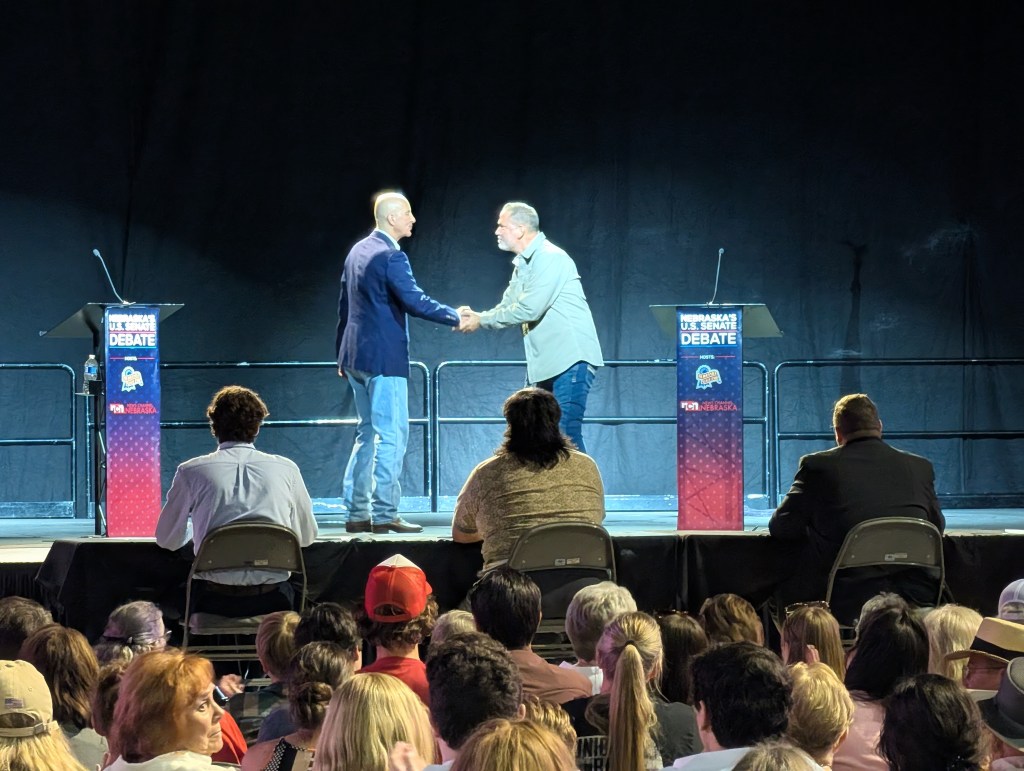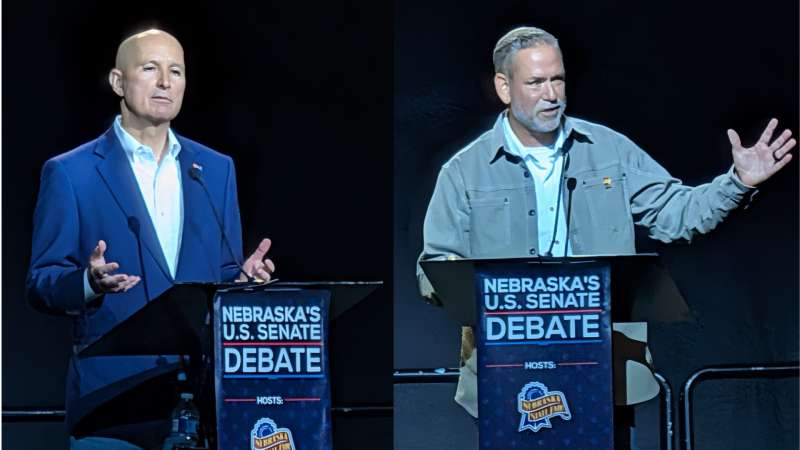
An unlikely handshake marked perhaps the only connection point on Tuesday between Incumbent Republican US Sen. Pete Ricketts and independent challenger Dan Osborn, shared after the rivals concluded their first—and likely last—Nebraska US Senate debate before the midterm elections.
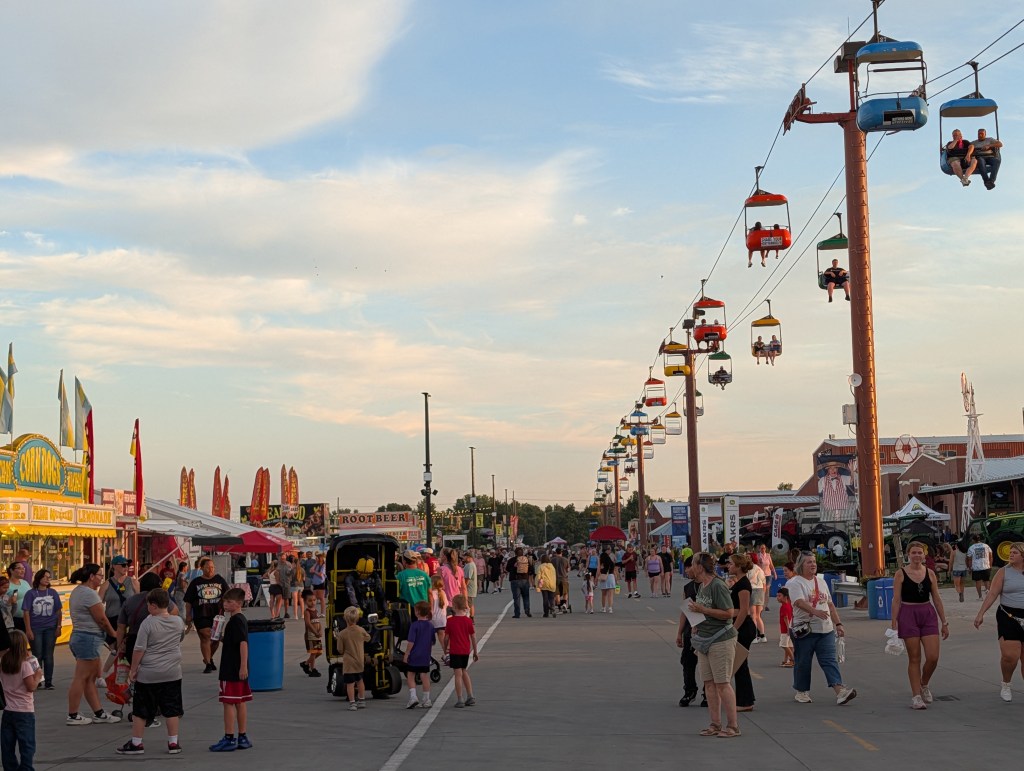
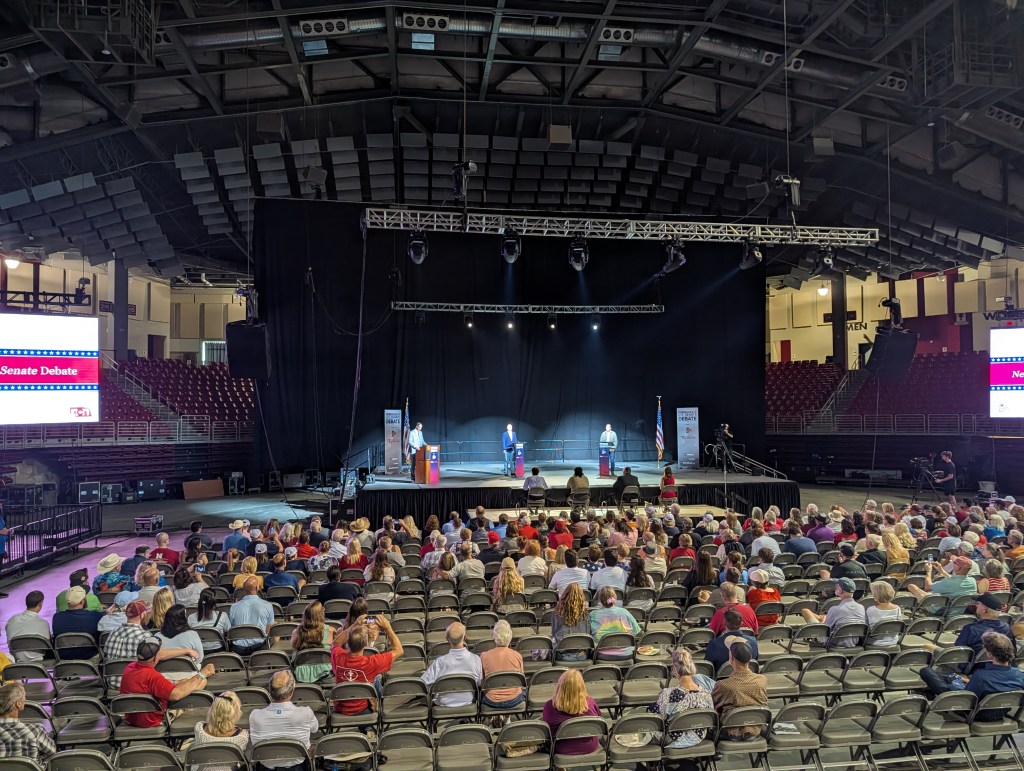
About 200 spectators escaped the day’s pounding heat to watch the highly anticipated clash in person at the Nebraska State Fair in Grand Island. Many more watched the event live online.
The match up on stage, formally moderated and fit with TV crews, marked the state’s first US Senate debate since 2020, and the first in Osborn’s political career. His opponent in 2024, incumbent Deb Fischer, declined his invitation to debate that year.
Before taking the stage, Courier Nebraska stopped by Obsorn’s state fair booth and asked if there was a contrast he hoped to draw with his opponent, in a race often tagged as the “millionaire vs. mechanic.”
“I think the contrast is self-evident,” Osborn said. “It’s the guy from the shop floor versus the son of a billionaire. That contrast is one of the really cool things about this race, where we come from, what we’ve done in our lives. Hopefully that’ll be showcased tonight.”
Here are three key themes that defined Tuesday’s debate.
Big Beautiful Bill
Over a year after it was signed into law by President Donald Trump, his signature spending and policy package, often called the One Big Beautiful Bill Act (OBBBA), continues to loom large in political discourse. Questions about the bill and some of its most controversial provisions gave ground for Osborn and Ricketts to diverge.
Since the bill passed on a 51-50 tie breaker vote from Vice President J.D. Vance in July 2025, Osborn’s loss to Sen. Fischer in 2024 is said to have been a consequential election outcome to push the legislation over the finish line. Osborn has maintained on the trail in 2026 that he would have voted against the bill.
Maintaining that he would operate in Washington as an Independent, Osborn used the vote to illustrate possible “leverage” for Nebraska.
“I wouldn’t have allowed the Big Beautiful Bill Act to strip a trillion dollars away from Medicaid,” Osborn said, affirming Ricketts’ accusation that he would not have supported the measure.
Responding to a question about those cuts to Medicaid and subsequent strain on rural hospitals, Ricketts “rejected the notion” that the program was defunded and defended new administrative requirements and conditions on eligibility, including work requirements.
Osborn cited the recent closure of the dialysis unit at the Chadron Community Hospital as a negative effect of the bill, forecasting “the dominoes are going to start falling.”
Executive powers
Since Trump assumed the White House in 2025, Congress has been increasingly criticized for failing to rein in the President’s authority to impose tariffs and exercise military force. Both candidates in Nebraska weighed in during the debate.
The question was posed: “Which tariffs are good, which are bad, and why?”
Ricketts answered saying that the president’s sweeping tariff regime is aimed at “leveling the playing field” and “defending agriculture.”
According to recent data, the average US family is on track to pay more than $2,500 in tariff-related costs this year—a 43% increase from the $1,745 average estimated during the first year of Trump’s second term. The president’s tariffs also hit farmers and ranchers with a double-whammy of lower exports and higher input prices. According to a review from the National Taxpayers Union, US agricultural exports declined and tariffs increased the cost of goods like farm machinery and agricultural chemicals by $958 million.
Osborn responded saying “targeted tariffs can work,” citing the automobile industry as an example. But said tariffs are plaguing his line of work—steam fitting, plumbing, HVAC.
“A domestic water heater is $600 more than it was pre-tariff war,” Osborn said. “The power of tariffs needs to go where it belongs, back to Congress. So they can act as a co-equal branch of government to really set this tariff policy right.”
Restoring congressional authority later propped back up when candidates were asked, “Do you support the ongoing war with Iran?”
Ricketts said there’s “no doubt” the US-Israel war on Iran is putting “pressure on Nebraska families,” but ultimately expressed support for continuing pressure and maximizing domestic fossil fuel production to counteract market disruptions.
Osborn, who often mentions his own history in the US Navy when discussing the topic, said he understood the argument for continued nuclear deterrence, but “we were promised no new foreign wars.”
“We are 185 days into a new foreign war. And Nebraskans are paying the price. We’re paying it in lives,” Osborn said. “We have to stop digging this hole. We have to give Congress back the power to act as a co-equal branch of government because only Congress can declare war.”
Partisanship
From the debate’s outset, Ricketts rhetorical strategy became clear: accuse Osborn of secretly being a Democrat in nonpartisan-sheep’s clothing as many times as possible over the course of 60 minutes.
By the debate’s end, Ricketts slung the phrase “Democrat Dan” about 40 different times—often numerous times in the same answer.
“We should actually have a third podium here tonight for him,” Osborn quipped in response.
Osborn brands himself as a “lifelong independent.” According to voter records, Osborn hasn’t changed his official nonpartisan status since he registered to vote in Douglas County in 2004.
Ricketts repeatedly cited campaign contributions in assigning Osborn the moniker, as well as tacit support from state Democrats—who elected not to run a candidate for the office in 2024 and this year.
Ignoring the bait to defend his nonpartisan bid’s support from Democrats or overcompensate to appeal to skeptical Republicans, Osborn reframed the race as “top vs. bottom” as opposed to “left vs. right.”
“This is what breaks my heart: the polarization of politics in this country,” Osborn said in closing. “When I set out in 2024, it was to bring people together. I’m tired of the division that’s been created in this country, over issues my opponent props up to keep us divided. We’ve got to shed our jerseys… We have seen $50 trillion migrated from the bottom 90% of Americans to the top 1%. We have a golden opportunity here, in Nebraska, to say that we are no longer for sale.”
The crowd applauded and the two candidates met center stage to shake hands.
The moderator reminded voters to exercise their right to vote on Nov. 3.