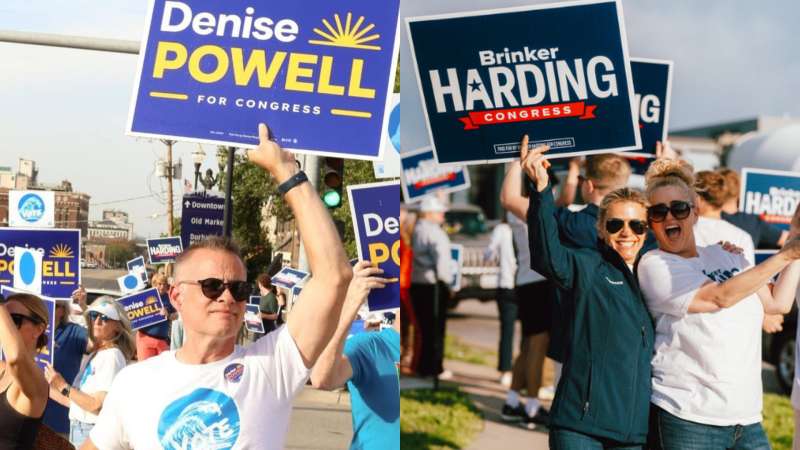
The overwhelming majority of voters are concerned with government corruption—and both candidates in Nebraska’s heated 2nd Congressional District race list solutions to the issue as a priority in Washington.
Here’s what Democrat Denise Powell and Republican Brinker Harding have proposed to restore confidence in public institutions and clamp down on political malfeasance.
Key issue
Numerous nationwide surveys have forecast “corruption” as top of mind for voters.
In fact, according to CNBC’s final survey before the Nov. 3 midterm election, voters are more concerned about government corruption than any other issue, including the cost of living and the Iran war.
The concern is pervasive too. 89% of US adults say government corruption is widespread, the highest level in 20 years, according to Gallup polling. It’s something Republicans, Democrats, and Independent voters agree on—with 90%, 93%, and 93% respectively saying the issue is a “big problem” according to the Brennan Center for Justice.
Therefore, Powell and Harding have an empirical motivation to position themselves as best equipped to tackle this subject.
Harding
On his website and the trial, Harding has propped up “affordability” and “accountability” as his two major campaign planks.
The Trump-endorsed vice-chair of the Omaha city council offers five bullet points on the subject, one materially addressing government corruption.
Harding, himself an office holder since 2017, says he supports “commonsense” congressional term limits. He hasn’t specified his preferred length of tenure for congressmembers, but said in a campaign video “long enough to learn the job and be part of the solution, but not long enough to be part of the problem.”
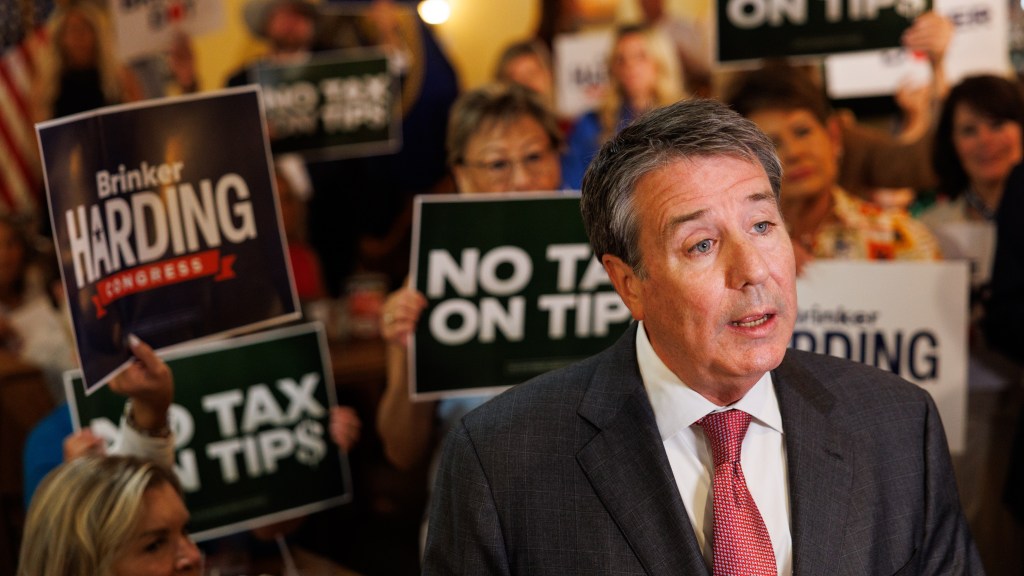
He’s also expressed support for a ban on congressional stock trading and jail time for insider trading. In another campaign video, scrutinized by the family of Omaha magnate Warren Buffett for invoking the Oracle of Omaha, Harding said “it’s called public service, not self-service.”
Harding has been endorsed by US Sen. Pete Ricketts, who introduced the Stop Insider Trading Act in the Senate after it passed the US House. It died in the upper chamber with no Democrat support after being criticized for not going far enough and called a “slap on the wrist.”
According to personal finance disclosures, Harding and his spouse have up to $125,000 invested in Pfizer and AbbVie, two of the largest pharmaceutical companies in the world.
Lastly, Harding has called for congressional salaries to be withheld during government shutdowns. The US Senate unanimously advanced this change earlier this year, and the House has pushed a similar measure out of committee.
Powell
On her website, Powell said her decade of advocacy and voter outreach with her political action committee (PAC)—Women Who Run Nebraska—has made a clear point: “many have lost faith in the government and believe politicians are looking out only for themselves, and not the people they were elected to represent.”
Powell offers eight bullet points on how she’ll combat government corruption if she’s elected to the US House, including several proposals not made by her opponent.
Powell says she supports banning members of Congress from becoming lobbyists for life, as well as an Ethics Code for the US Supreme Court to ban special interest gifts, require financial disclosure, and conflict of interests recusal requirements.

Further, Powell has advocated for overturning the Supreme Court’s pivotal 2010 decision that struck down limits on independent political expenditures— Citizens United v. FEC, often referred to simply as Citizens United.
Powell has been endorsed by End Citizens United—a PAC advocating for the decision’s reversal.
Overlapping with Harding, Powell also supports a ban on congressional stock trading and enacting congressional term limits “to fight corruption and ensure new thinking and ideas.”
Compare, contrast
While both candidates posture their campaigns as fighting against corruption, Powell’s position appears more forceful and detailed.
Harding’s anti-corruption platform is slimmer, but more focused on his three prescriptions.

NE-02 encompasses all of Douglas County and the vast majority of Omaha, the state’s largest city. The district also stretches into Saunders and western Sarpy counties. According to October 2026 voter registration data, of the district’s more than 423,000 registered voters, Republicans make up about 37%, Democrats 34%, nonpartisans 26%, Libertarians 1.5%, and Legal Marijuana NOW voters 1.1%.
Outgoing Rep. Don Bacon’s ability to hold the seat since 2016 is often attributed to his center-right persona in Washington and his labeling by some as a “maverick” for occasionally breaking with Republican Party leadership. This complex identity of the district is what Harding and Powell are trying to appeal to.
The general election is Nov. 3.