A 6-year-old boy recently came across a conulariid fossil while rummaging around in the rocks at Schramm Park State Recreation Area. Now he’s being hailed as the first person to find such a fossil in Nebraska in more than half a century.
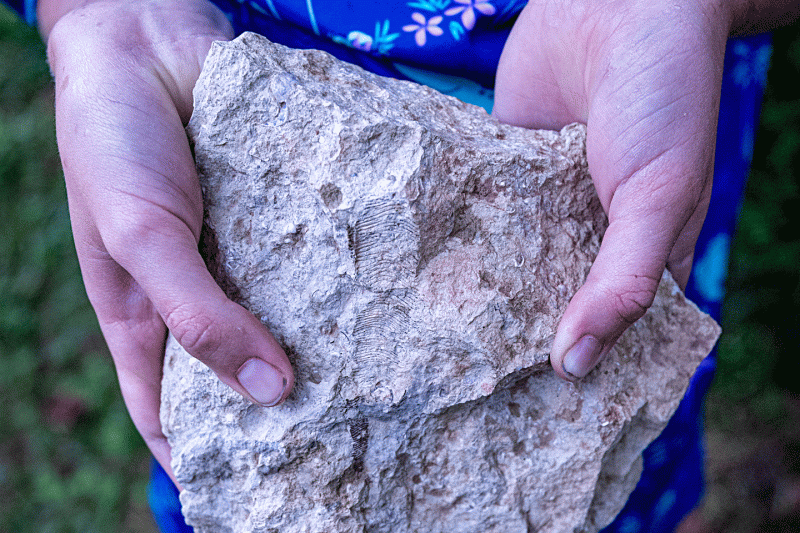
Leo Youngdahl had been searching for crinoids, known as sea lilies or feather stars, which are common to eastern Nebraska. Instead, the rock he turned over turned out to host a 2.75-inch imprint of a conulariid.
Youngdahl knew he had something with this herringbone-style fossil, but wasn’t sure what. He took his discovery to Kelly Ekue, outdoor education specialist at the Schramm Education Center, who didn’t recognize it as one of the six common fossils found at the park.
She sent pictures of the specimen to her network of experts, who eventually identified it as a conulariid.
The ancient marine animal is described as “a jellyfish-like creature shaped like an upside-down pyramid.” It lived between 200-500 million years ago. The last known Nebraska conulariids were found 55 years ago, just across the Platte River in Louisville and Weeping Water.
“It is really amazing that among all those rocks in the Schramm outcrop, Leo not only picked up this one, but recognized it as a fossil and thought to ask about it,” Ekue said in this release from the Nebraska Game and Parks Commission.
Youngdahl agreed to let the fossil remain at Schramm, where Ekue and other staff members will feature it in their educational programming.
Meanwhile, the young amateur archaeologist will continue his search for a complete crinoid fossil, or any of the others that can be found along the Platte.
Comprising exposed sections of bedrock that are about 350 million years old, a time when Nebraska was covered by a saltwater sea, the Schramm Park outcrop is a perfect spot for Youngdahl to continue his searching.
Ekue reminds visitors who want to join in that search to bring a camera but no unauthorized tools like picks, hammers, or shovels. And never go under an overhanging rock.
Most of the finds at the park are small marine invertebrates that are smaller than a penny, fossilized in the limestone, shale, and sandstone.
“Delight in all discoveries, not just the big ones like a rare fossil, but the little ones, too,” Ekue said. “A neat mushroom, a weird bug, or a pattern in the clouds.”