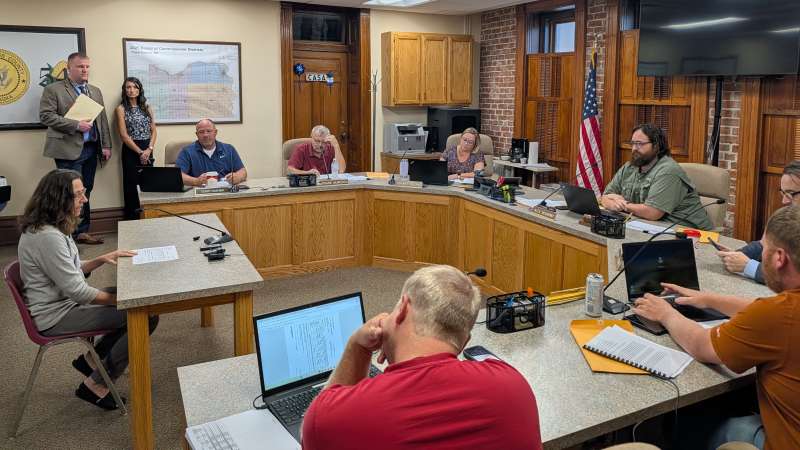
The Cass County Board of Commissioners voted unanimously Tuesday morning to approve a 12-month moratorium on data centers, also tabling a vote on proposed regulations until next month.
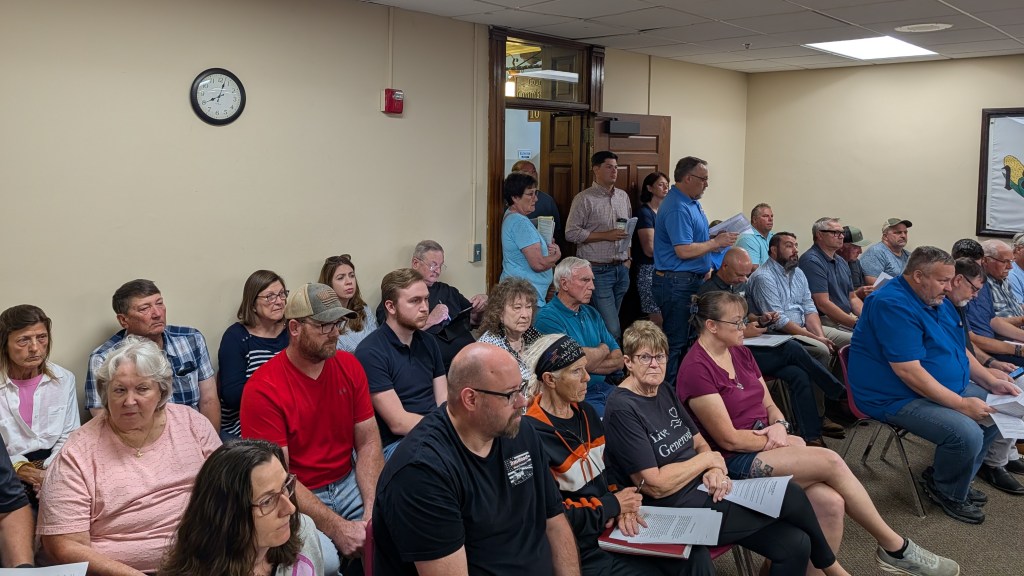
Local residents teemed out of the small hearing room in the county courthouse, in Plattsmouth, a city of about 6,600 residents located about 20 miles south of Omaha. The vote Tuesday follows a public hearing in mid-July, in which the local Planning and Zoning Commission voted 7-1 to send the set of regulations and 18-month moratorium recommendation to the board. Approximately 150 residents attended that meeting, held in the village of Weeping Water.
Public interest, and opposition, appeared sustained over the month since the last hearing. Roughly 50 residents packed the hearing room Tuesday and offered an hour’s worth of testimony before the board.
The board’s 5-0 vote adds Cass to a growing list of Nebraska counties enacting temporary suspensions on data center projects seeking to occupy large portions of land, generally near rural communities in the state. The recommendation for a 12-month moratorium was put forth by the county’s District 4 representative Daniel Stohlmann. The decision to table discussions on the proposed set of regulations to the board’s Sept. 22 meeting also received unanimous support.
The proposal comes from Tenaska—an Omaha-based private energy company. Earlier this year, Flatwater Free Press reported that Tenaska and Google were partnering to build a 2,000-acre natural gas power plant and data center in southeast Nebraska. Tenaska optioned 1,354 total acres in Cass County along Highway 75 south of Murray and Beaver Lake in June, according to WOWT.
Tenaska is the same company behind other proposals in Gage and Otoe counties, the latter of which passed a one-year moratorium, while the former is still taking the idea under consideration.
Before residents took to the mic, a zoning administrator for the county clarified that no official proposal or application for a data center project has yet been submitted.
‘How do we grow?’
The set of regulations and the moratorium proposal were separate items on Tuesday’s agenda. In total, more residents chose to speak on the moratorium. They were each given two minutes to speak.
Dustin Marvel, manager of government and community relations for the Omaha Public Power District, spoke in opposition to the proposed set of regulations, asking the board to consider removing any language that “encroaches upon OPPD or Nebraska Public Power District’s exclusive authority to provide and regulate electrical service in Cass County.”
“The Nebraska Public Power model is intentionally designed so that the critical electric system decisions are made by public power utilities charged with those territories,” he said. “Cass County absolutely has the authority to make reasonable land use zoning recommendations. We just ask that you coordinate with OPPD as you’re developing that language to ensure we’re both working together effectively to address this issue, which obviously has a lot of public interest.”
Several testifiers on Tuesday also spoke before the Zoning Commission last month. One familiar face was Jayden Speed, a resident of Nehawka and former candidate for the Legislature in District 2, who manages the citizen group Cass County Data Center Watch.
Speed offered neutral testimony on the proposed regulations, specifically asking for commissioners to consider widening the distance a data center could be from residential areas, set at 500 feet in the current regulatory draft. In comparison, zoning laws in Cass County mandate that wind energy facilities be at least 2,500 feet from residential or ag property.
“These regulations start the discussions our community must have,” he said. “How do we grow? How do we usher economic development while also protecting our land, our natural resources, and our residents? These regulations start that discussion, but they don’t end it. We have a lot of work left to do.”
Speed would later testify in support of the moratorium, calling for more public hearings, saying “we have to hit the brakes and take account of our priorities.”
A development opportunity
Also offering neutral input on the regulations was Mike Gage, president of the Nebraska state AFL-CIO. He said the labor movement is not opposed to data centers or technical advancement, but “opposed to development that asks working people to bear the cost while corporations collect the benefits.”
“Data centers should be built, operated, maintained, and secured with good union jobs and high labor standards,” Gage said. “Before a major data center receives tax incentives, subsidies, special utility arrangements, or other public benefits, the developer should sit down with workers, unions, local governments, and the surrounding community and negotiate a community benefit agreement.”
When speaking on the moratorium recommendation, Gage again testified in the neutral, lobbying for a community benefit agreement but adding he didn’t want Cass County to miss an “opportunity for development.”
One concern, repeated by multiple residents testifying in support of the moratorium, was if proposed data center projects would be abandoned over the next decade due to technological advancements. One resident referenced the infancy of computer technology, when early digital computers occupied entire rooms—but now barely occupy one’s pocket.
One testifier, identified as Mark from the village of Murray, held back emotion as he recounted Tenaska approaching his family with a high dollar offer to purchase some of their land in 2024.
“This farmland was bought by my great-grandparents over 100 years ago. I told them we’re not going to sell. I hoped that everybody else would feel the same way,” he said.
Throughout the hearing, nearly all testifiers spoke in support of the moratorium or in the neutral. One resident—Mike, who lives in Cass County near Beaver Lake—spoke against the moratorium, touting possible economic opportunities associated with a project of this scale for the community.
“You can have a good opportunity here,” he said. “I don’t see anyone using less data and internet. And with AI, good, bad, or ugly, it’s coming. And I would rather see it controlled in this country than somewhere else.”
Two prospective candidates for local office also spoke Tuesday on the measures. Brad Cowan, candidate for Cass County Commissioner in District 2, spoke in the neutral on the regulations and in support of the moratorium.
Caitlin Knutson, a Democratic candidate for District 2 in the state Legislature, testified in the neutral on the moratorium.
“We have arrived at this moment because government has not reached it appropriately,” Knutson said. “The size and scope of these projects, the placement of them, matters greatly to people. More needs to be done to bring them on board.”
What comes next
Following public hearing, commissioners decided to continue discussion on the proposed set of regulations on Sept. 22, then voted unanimously to enact the moratorium.
“If we hit the end of this moratorium and we feel that we need more time, there’s always the opportunity to extend,” said Alexander DeGarmo, board representative for District 3. “Or, if we adopt directives before, there’s always an opportunity to end the moratorium sooner. This is just a baseline to give us, at minimum, 12 months.”