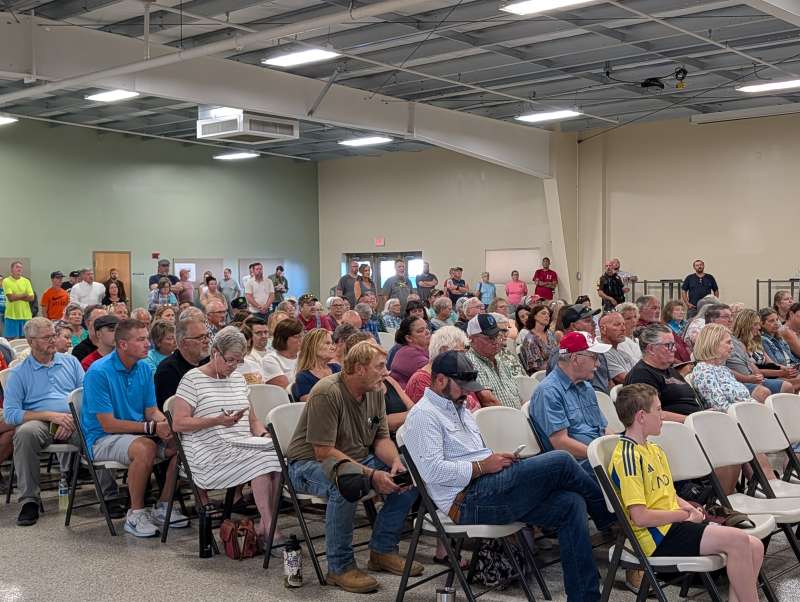
Before a packed warehouse room on the Cass County Fair Grounds on Monday, the local Planning and Zoning Commission voted near-unanimously to forward a proposed set of regulations—and a moratorium—on data centers to the county board.
This was the second time that the residents of Cass County were able to voice their thoughts on data centers in their area. The initial public hearing had been held two months prior, on May 11, but the meeting was sparsely attended.
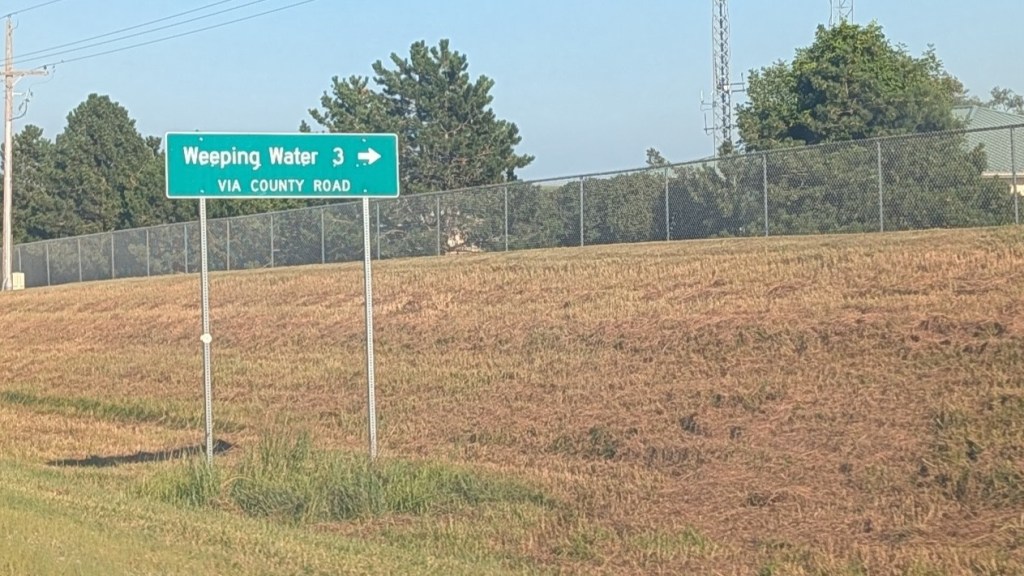
Monday’s meeting drew about 150 people to the Fairgrounds Exposition Building located in the village of Weeping Water, about 40 miles east of Lincoln.
The agenda item before the commission on Monday did not determine whether or not a data center could be established in Cass County, but rather the “standards and procedures” that would apply if a data center proposal were to be presented in the area.
While the considered amendment was not intended to stop development, local residents argued to do so out of concern about the potential environmental and economic drawbacks.
Prior to the 30-minute public comment period on the amendment, Commissioner Nicholas Rayer recommended that the county’s board of commissioners consider a flat out moratorium—or temporary suspension—on data centers. His recommendation was 18 months, which is the same length of time as the moratorium advanced in Gage County in June.
The Cass County Board of Commissioners will ultimately determine whether a moratorium is adopted, and if so, its length.
If approved, Cass would join a swelling number of Nebraska counties grinding data center construction to a standstill.
The proposal comes from Tenaska—an Omaha-based private energy company. Earlier this year, Flatwater Free Press reported that Tenaska and Google were partnering to build a 2,000-acre natural gas power plant and data center in southeast Nebraska. Tenaska optioned 1,354 total acres in Cass County along Highway 75 south of Murray and Beaver Lake in June, according to WOWT.
Tenaska is the same company behind other proposals in Gage and Otoe counties, Otoe County passed a one-year moratorium..
Prior to hearing from residents, the Planning and Zoning Commission voted to recommend that the Board of Commissioners conduct a third-party review of the set of regulations. Rayer chimed in and made an additional motion to suggest the county commissioners consider a date center moratorium in addition to the proposed regulations.
The crowd erupted with cheers and applause. Rayer was commended for his suggestion the rest of the meeting.
The vote to do so was near unanimous from the eight-member board. Commissioner George Tesar Jr. cast the lone no vote
Public testimony
The room was surrendered to residents, who took the next half hour to address their appointed representatives. Each one spoke in total opposition to the project—and data centers, at large. Their concerns ranged from environmental to economic, with nearly every testimony met by hand-clapping ovation.
“My question comes to this: I’ve not heard anything about what’s in it for us,” said Terry Tilson, a resident of Plattsmouth. “What is the benefit to our people to do this? What’s in it for the people? Because that’s what you’re here for.”
“What happens when the AI data centers come in, and we go through another drought?” asked Pam Kragt, a Plattsmouth resident. “They will get the water first. We will not.”
Kragt added, “This is not a partisan division … First thing I can think of in a long, long time where nobody gives a crap if you’re a Democrat or a Republican.”
“Tenaska has gone about this before coming to the community. They went to landowners first and told them, sign this piece of paper and we’re going to put some money in your pocket,” said Jayden Speed, a resident of Nehawka and former candidate for the Legislature in District 2. “That’s why people are angry.”
Speed said the proposed plant would be the largest data center in the state, possibly consuming between 1,000 and 3,000 megawatts of electricity—more energy than the city of Lincoln would eat during peak summer demand, according to Flatwater Free Press’ report.
“What Tenaska is trying to do is find the weakest link. They are trying to find which planning commission, which county commission can they push around,” Speed said. “Otoe County wouldn’t let them push them around. Gage County wouldn’t let them push them around. So now they’ve come to Cass County.”
“We, the people, are saying we don’t want this,” said Kristen, a Plattsmouth resident who walked around the room with a sign reading, “We the People, have had enough.”
She added, “We deserve clean air, clean water. For my kids, my grandkids. It’s not fair that 12 people that don’t know me get to decide what my children will be exposed to.”
The proposed center’s size is notable, especially in rural Nebraska. The site would span nearly the same acreage of Plattsmouth, Nebraska, itself—which stretches about 2,100 acres.
“Counties across the state are trying to figure out how to deal with data centers. And nobody’s prepared,” said Edison McDonald, director of development and government relations with GC Resolve, a communications company focused on environmental issues. “What’s really, truly important is making sure that you take the time to really be truly thoughtful about this.”
“The regulations that you write today will outlive every developer, every elected official, and every one of us in this room,” said the last testifier of the night, Shauna Snyder, who is running for mayor this year Plattsmouth. “Please make sure they are written, first and foremost, for the people of Cass County.”
Upon the meeting’s end, Commissioner Rayer was rushed by attendees wishing to shake his hand and thank him for recommending the moratorium.
The Cass County Board of Commissioners are likely to consider the Planning and Zoning Commission’s recommendations at their next regularly scheduled meeting on August 25.