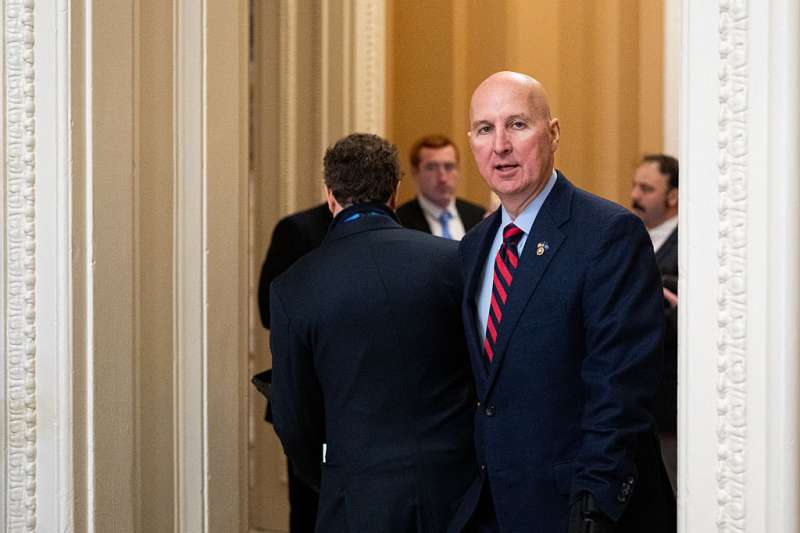
When Nebraskans head to the voting booths in November, they’ll face an interesting panel of candidates vying for US Senate. The seat is currently held by Republican Pete Ricketts, the state’s former governor, who’s running for another term.
Ricketts is a multi-millionaire whose legacy in the Cornhusker State includes a defining stance on the legalization of medical marijuana—an issue that the overwhelming majority of voters in the state have approved of.
A whopping 71% passed a measure in 2024 to legalize medical marijuana, and 67% voted in support of a second measure to regulate the industry, but state legislators have dragged their feet since. Now, as they pull up to another fall election, Nebraskans are no closer to obtaining a legal prescription for the drug than they were on voting day two years ago.
So what gives? And why is Ricketts, a politician who has called the drug dangerous and warned it will “kill your kids,” so set on preventing voters from getting what they want?
“He is not representing Nebraskans, and does not seem to care that he is not,” said Crista Eggers, a campaign manager for Nebraskans for Medical Marijuana, a group whose mission is to lead the fight in medical cannabis education and advocacy for patients in Nebraska.
“I truly believe this opposition must stem from money, pharmaceuticals, and alcohol. I cannot truly tell you factually what it is,” she added.
Voters will get another chance to weigh in on the issue through their ballots this November, when Ricketts will likely face mechanic Dan Osborn for the Senate seat.
“The dichotomy of positions on this issue couldn’t be more stark,” said Morgan Fox, political director of NORML, a nonprofit and nonpartisan consumer advocacy group for cannabis policy reform. “You’re looking at Sen. Ricketts versus Dan Osborn. Dan Osborn has a sensible and pragmatic approach to this issue.”
Nebraskans vote for medical access
The push for medical marijuana access took center stage in 2024 when voters in the state overwhelmingly approved two ballot initiatives to make access a reality for patients in Nebraska.
The first, known as the Nebraska Medical Cannabis Patient Protection Act, made it legal for patients to obtain up to five ounces of marijuana for medical conditions. The second, known as the Nebraska Medical Cannabis Regulation Act, legalized possession, manufacturing, distribution, delivery, and dispensing of marijuana for medical purposes. It also established a regulatory body for the program, known as the Nebraska Medical Cannabis Commission.
Since then, Nebraskan lawmakers have tried to oppose the initiative by claiming signatures for the provision were fraudulently obtained or falsified. Former Sen. John Kuehn filed a lawsuit, which was quickly dismissed. Some have pointed out that Kuehn and Andrew La Grone, one of the attorneys in the lawsuit, have connections to Ricketts, who appointed each of them to state positions.
Members of the Nebraska Medical Cannabis Commission approved temporary regulations for growing the plant, but they have yet to be signed by Gov. Jim Pillen (R). If they aren’t signed by July 15, they’ll expire. Proponents believe lawmakers opposed to the initiatives—specifically Pillen and Attorney General Mike Hilgers—are trying to run out the clock.
In the meantime, President Donald Trump moved to reclassify the drug from a Schedule I to a Schedule III narcotic, lowering criminal punishments for possession or use of the drug recreationally. Ricketts opposed this as well.
“When you have folks like Pete Ricketts who are vehemently anti-cannabis policy reform sitting in Congress, they are a safe bet to co-sponsor any sort of anti-cannabis bills and to exert influence on a federal level that directly impacts patients in Nebraska in a negative fashion,” Fox said.
In May, Attorney General Hilgers went so far as to join the attorneys general of Indiana and Louisiana in a lawsuit seeking to stop the reclassification, claiming Trump’s team broke the rules by pushing for the change without providing notice or an opportunity for public comment.
Ricketts’ track record with marijuana in the state
Ricketts has been vocal in his disapproval of marijuana as a recreational drug, but he’s also fought against medical applications.
“(Ricketts) has spent years being opposed to the issue of medical cannabis access in the state of Nebraska,” Eggers said. “What we have now seen is that Sen. Ricketts has taken that opposition to Washington, where he is actively working against what the voters in this state overwhelmingly support.”
In 2024, Ricketts met with a family whose son killed himself after suffering a “psychotic break” they said was brought on by the use of high-potency marijuana products. Ricketts then introduced “Randy’s Resolution,” which was aimed at education and research into high-potency marijuana.
“The average THC potency in marijuana has increased by 287% since 1995, and it’s killing young Americans like Randy Bacchus Jr.,” Ricketts said in a release at the time. “Randy’s Resolution is a call to arms for every level of government to do more to combat the dangerous, addictive high-potency marijuana products flooding the market today. We can’t stand by and do nothing while the big marijuana lobby gets the next generation addicted to a drug that causes mental health disorders and cognitive impairment.”
Contrary to Ricketts’ statement, medical marijuana programs in the US are tightly regulated, and data shows that serious adverse events are rare—while many patients report meaningful relief from symptoms like chronic pain, nausea, and seizure frequency.
In 2025, Ricketts met with Robert Kennedy Jr., then President Trump’s nominee for US Secretary of Health and Human Services. Ricketts wrote on Facebook that they discussed the importance of a few key issues, including “preventing the expansion of marijuana.”
This year, Eggers said Nebraska was left out of a federal amendment that would have prevented the government from interfering with state-authorized cannabis programs.
“Our delegates, all federal delegates including Pete Ricketts, did not do their job to make sure that Nebraskans were covered in this federal law that was passed,” Eggers said. “When we sounded the alarm at the impact of Nebraska being left off, we saw Sen. Ricketts continue his opposition in his comments about how he does not believe or support the issue of medical cannabis.”
Contender Dan Osborn’s stance on marijuana
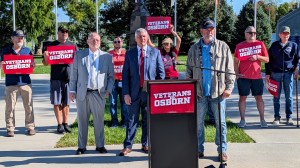
Ricketts will likely face a relative unknown in this year’s Senate race. US Navy veteran Dan Osborn quit his job as a mechanic to run against Ricketts for the seat. It’s Osborn’s second foray into politics, after he lost the same race in 2024 to Republican Deb Fischer by about 7 percentage points—a narrow loss in a state that carried Trump by 20 points.
For his part, Osborn has said he supports the will of voters in the state, and called the drug a lifesaver for people with epilepsy as well as veterans with post-traumatic stress disorder.
“If there is ONE person most to blame for medical marijuana being stalled in our state, it is unquestionably Pete Ricketts,” Osborn wrote on Facebook in November 2025. He later suggested Ricketts and other wealthy elites were rigging the system to “strangle” the bill with added regulations.
Osborn has also voiced support for Trump’s reclassification of the drug at the federal level, criticizing Ricketts for trying to stop it.
“Nebraska farmers could be growing this. Nebraska small businesses could be selling it,” Osborn wrote in May. “Instead, Pete’s keeping that money out of our state and hurting patients and caregivers.”
In June, Osborn shared a Politico story on Facebook highlighting a US Supreme Court decision ruling that users of illegal narcotics shouldn’t be stripped of their gun rights. Osborn said he applauded the ruling.
“People who consume marijuana should be able to purchase and possess firearms. This is common sense,” he wrote, adding: “The Second Amendment applies to ALL Americans, regardless of what medicine you take or what you do in your free time.”
Eggers said Nebraskans for Medical Marijuana doesn’t endorse candidates, instead focusing on voter education on the topic, but she said Osborn has a better track record of voicing his approval of access to medical cannabis.
“We do see very different stances with Ricketts being completely opposed and Dan Osborne being in support,” Eggers said.