In Nebraska, a fight to meaningfully raise the minimum wage was marred by state lawmakers. City leaders have carried the baton, despite legal challenges.
The battle has consumed the attention of voters and elected officials alike for over a decade—and it was reignited last week when Nebraska’s Republican Attorney General Mike Hilgers announced he was taking legal action against the city of Lincoln over its city-level minimum wage ordinance.
According to Hilgers, Lincoln’s proposal is an “unconstitutional power grab” and he’s asking a judge to enjoin the city and halt the ordinance’s implementation.
But proponents for the measure are not deterred in their efforts to continue to push for Nebraska’s minimum wage workers to get a pay boost.
Ken Smith, economic justice program director for Nebraska Appleseed, has closely followed the measure. Nebraska Appleseed is a nonprofit, nonpartisan public interest law firm and advocacy group that was part of the ballot measure’s initial coalition. Smith underlined the ballot measure’s bipartisan, widespread support across the state’s dense urban centers and smaller rural communities.
Setting aside principle, yielding to the measure’s success would be a safe move given its support across the political spectrum.
“This was an issue that really did unite Nebraska voters,” Smith told Courier Nebraska. “Adjusting the wage so it kept pace with cost-of-living increases was a huge element of that, virtually guaranteeing that our wages would not, once again, fall behind the cost of living.”
How we got here
Nebraska’s minimum wage battle dates back over a decade to 2014, when voters approved Initiative 425 at the ballot by 59.4%. This measure increased the state’s minimum wage from the federal standard of $7.25/hour to $9/hour by 2016.
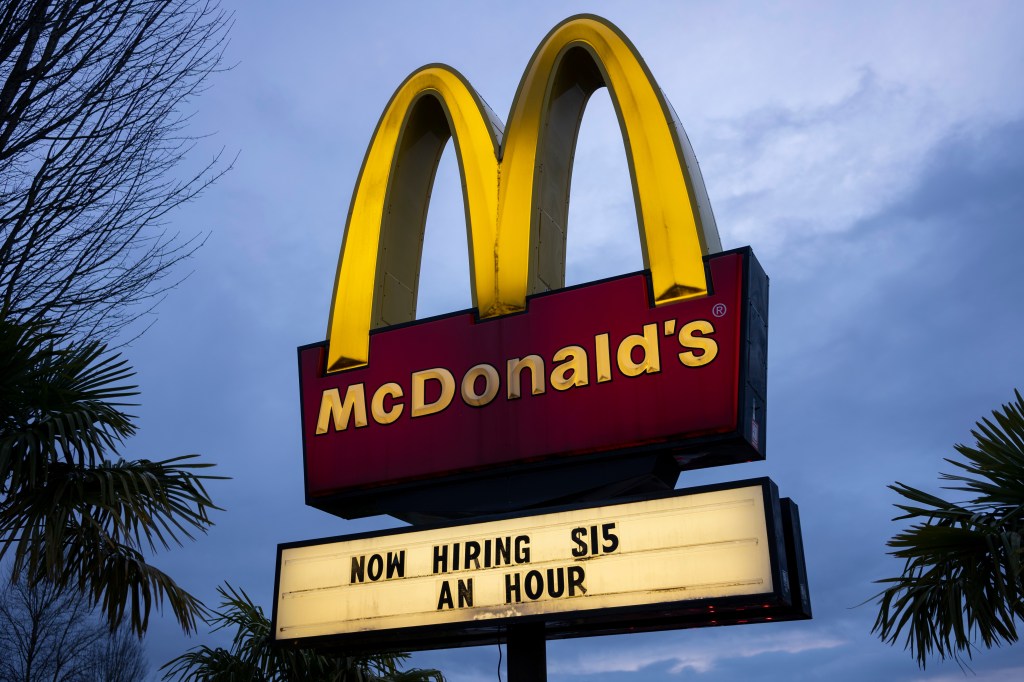
But the current legal conflict stems from Initiative 433, dubbed Raise the Wage Nebraska, a ballot initiative circulated statewide in 2022. The measure, if passed, promised voters a gradual increase in the state’s wage floor, still resting at $9/hour, but notching up annually by $1.50 through 2026 to $15/hour.
Further, the initiative sought to end future wage stagnation by mandating yearly adjustments to the state’s minimum wage based on the Consumer Price Index for All Urban Consumers (CPI-U) for the Midwest Region—the metric used to determine the cost of living. This provision would begin in January of 2027.
Come time to submit signatures to the Secretary of State’s office for ballot certification, the initiative’s campaign handily cleared the requirement of roughly 90,000 signatures, turning over troves of boxes containing more than 150,000 signatures.
At the ballot box in 2022, Nebraska voters decidedly approved the measure. Just under 59% voted “yes” on the question.
The initiative was received most favorably in the state’s most populous counties, with Douglas voting “yes” by 68.4% and Lancaster by 64.7%. Still, the measure was also approved narrowly by voters in smaller, more rural counties like Thurston, Johnson, and Greely—winning here by just 19 votes (503 to 484).
The measure was implemented, and Nebraska’s minimum wage climbed mostly without controversy until 2025, when state Sen. Jane Raybould—a former Lincoln city councilwoman and then-Vice President of B&R Stores, Inc., the parent company of Super Saver, Russ’s Market, and other Nebraska grocery stores—introduced LB 258.
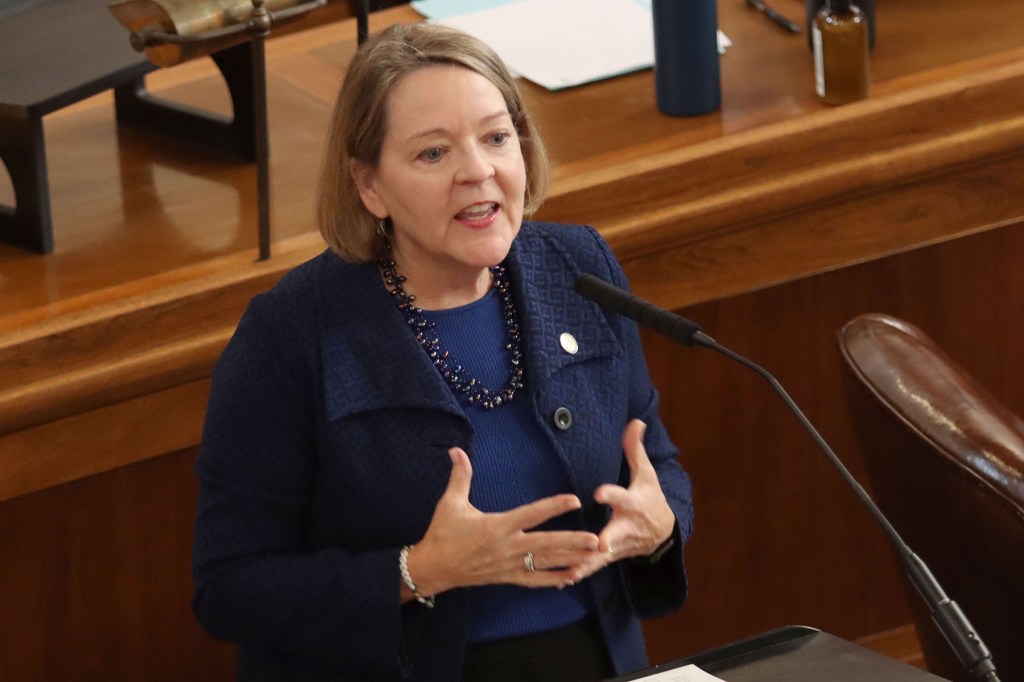
The bill, which was approved by the state Legislature in a 33-16 vote the next year, modified the 2022 ballot question, primarily fixing or capping future increases to the wage floor at 1.75% annually. Additionally, the bill created a new sub-minimum “youth wage” option for employers, allowing workers aged 14-15 to be paid $13.50/hour, with increases of 1.5% starting in 2030.
Under Raybould’s bill, one wage did increase, however, raising the state’s little used 90-day “training wage” to $13.50—up from $5.44, a number calculated as 75% of the federal minimum wage of $7.25/hour.
Raybould, a registered Democrat and representative of District 28 in central Lincoln, cemented this effort as her political finis upon announcing she would not seek reelection in 2026.
‘Inferior political subdivisions‘
While this amended version of the initiative became law, local officials acted to preserve the 2022 ballot measure’s original language.
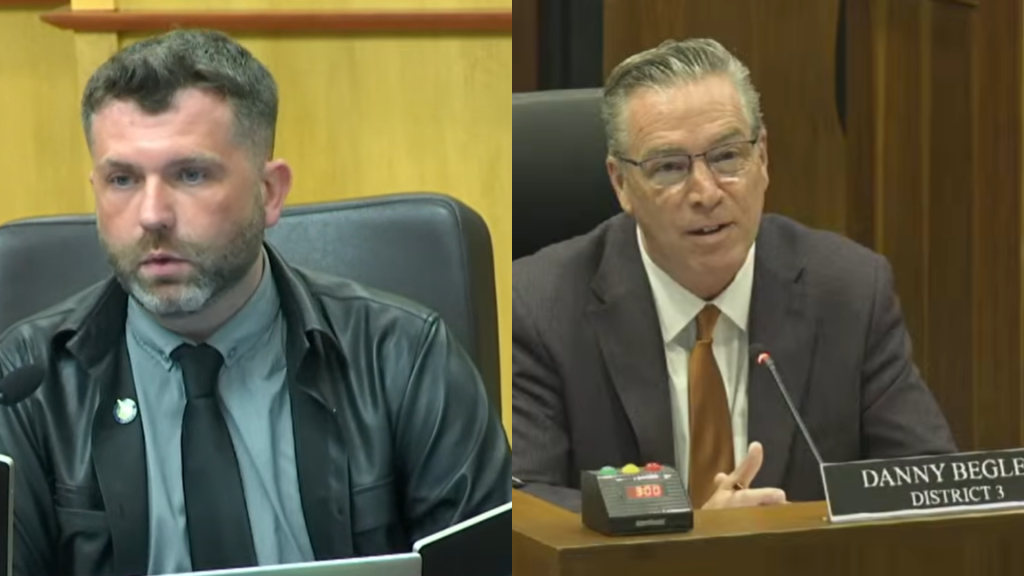
James Michael Bowers, who represents northeast Lincoln, introduced an ordinance in April to maintain the original 2022 minimum wage standard, “without exceptions.”
This meant retaining the 2022 measure’s original, fluid cost-of-living adjustments and doing away with the sub-minimum youth wage. The Lincoln City Council voted 6-1 to adopt the ordinance in May.
Come June, Omaha followed suit, with City Council President Danny Begley, a union leader with IBEW Local 1483, introducing an ordinance effectively the same as Lincoln’s. Omaha council members held a public hearing last week on the proposal, with a vote slated for mid-July.
“This isn’t reinventing the wheel,” Begley told Courier Nebraska. “The voters passed this, then the legislature changed it. I’m with the voters on what they wanted. If there’s a legal fight, I’m a union guy. The labor movement didn’t get where it is today by rolling over. Some things you got to fight, and this is worth fighting for.”
Begley said he’s “confident” the ordinance will have the support of Omaha Mayor John Ewing Jr.
During a June 18 press conference announcing the lawsuit, Attorney General Hilgers argued that Lincoln—as a city—could not determine its own wage floor, and the attempt runs counter to its authority under state law.
“They are not small states unto themselves,” Hilgers said of Lincoln and Omaha. “They ultimately are inferior political subdivisions that are inferior to the state of Nebraska.”
Hilgers said his office was waiting to take legal action against Omaha for its ordinance, since the vote was still to come.
‘A complete attack‘
Smith with Nebraska Appleseed has experience as an attorney in consumer protection and civil litigation. He said he understands Hilgers’ core legal argument of local control vs. statewide authority, but noted that both Omaha and Lincoln operate under a “home rule charter,” which generally allows municipalities to manage their own affairs with a high degree of autonomy, instead of being strictly governed by state statutes.
“The cities of Omaha and Lincoln have broad lawmaking authority under this charter,” Smith said. “The Attorney General is casting that authority in a rather aggressive way that cuts against that ability for cities to make their own laws.”
He clarified: “I’m not saying cities have a blank jurisdictional grant to do whatever they want, because certainly there are parameters… The question is where those parameters are.”
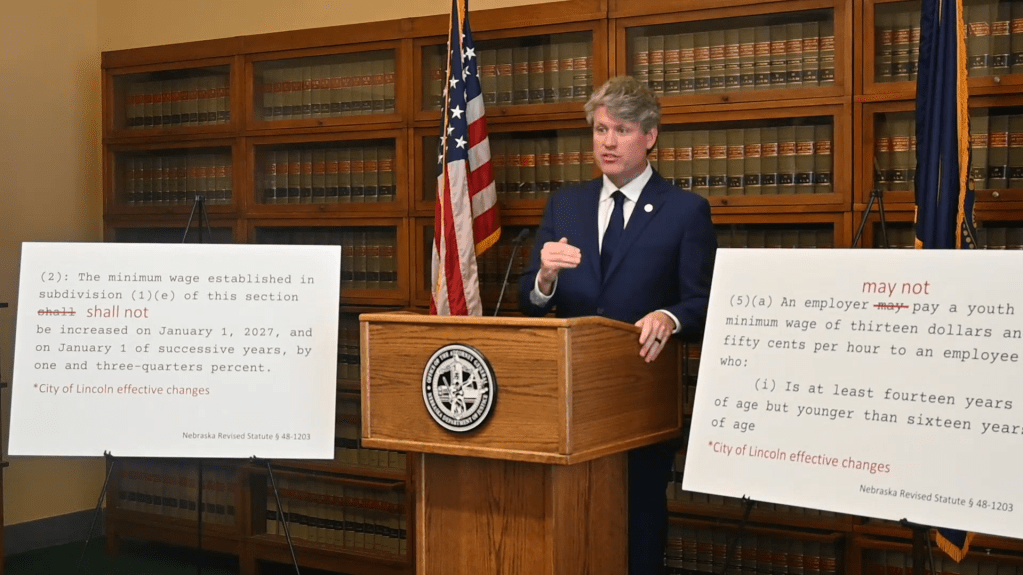
Office of the Nebraska Attorney General
Smith also identified the “floor versus ceiling” question as a key legal issue in this case. In defending their ordinances, Lincoln and Omaha are likely to argue that the state’s minimum wage law sets a baseline, rather than a limit, and that cities have the authority to establish higher standards.
“The question here is whether state law establishes the minimum protections that every worker receives, or whether it goes further than that, and prevents cities from providing greater protections,” Smith said.
Smith also pointed to the concept of “dual compliance.” The cities could argue that because businesses can comply with both the statewide and citywide minimum wage requirements, the local ordinances do not conflict with state law.
Hilgers’ Democratic challenger this November, Jocelyn Brasher, reacted on social media saying, “This lawsuit is a waste of the Attorney General’s time and taxpayer resources. Nebraskans deserve an Attorney General who respects the will of the people, protects their rights, and uses the office to serve them—not sue them.”
Meanwhile, advocacy continues.
Gab Rima, co-founder of Strongly Worded Letters Omaha, a civic group focused on engagement and education, testified before their city council last week in support of Begley’s ordinance and tells Courier Nebraska that the support in the room was “overwhelming.”
“It protects workers and it also protects democracy,” they said of Begley’s proposal. “Something that passed on a ballot with over 70% of the vote in Omaha, to overturn something with that level of popularity just feels like a complete attack on our rights as voters.”
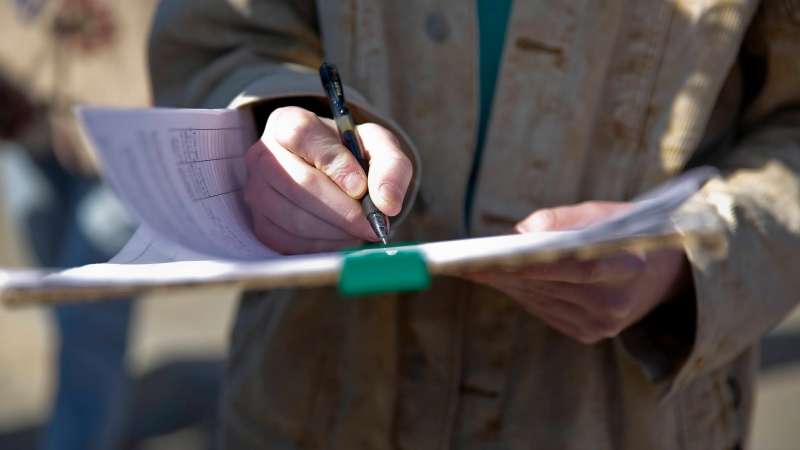
Harkening to the group’s name, Rima is hosting a postcard-writing party on Thursday, June 25, at Omaha’s Urban Abbey from 5:30 to 7:30 p.m. Attendees will be assisted in jotting handwritten letters to their representative on the council, sharing their thoughts and feelings about the ordinance.
“There can be something really psychologically effective about seeing a handwritten note from a constituent, rather than an email,” they said. “If you can’t make it for in-person testimony where they can see your face, making them see handwriting, I think helps them imagine the person behind the message.”
The Omaha City Council will vote on its proposed ordinance on July 14. Lincoln Mayor Leirion Gaylor Baird said the city’s legal team is waiting to see Hilgers’ suit, and will review it once received. Gaylor Baird said she supported the council in passing the ordinance.