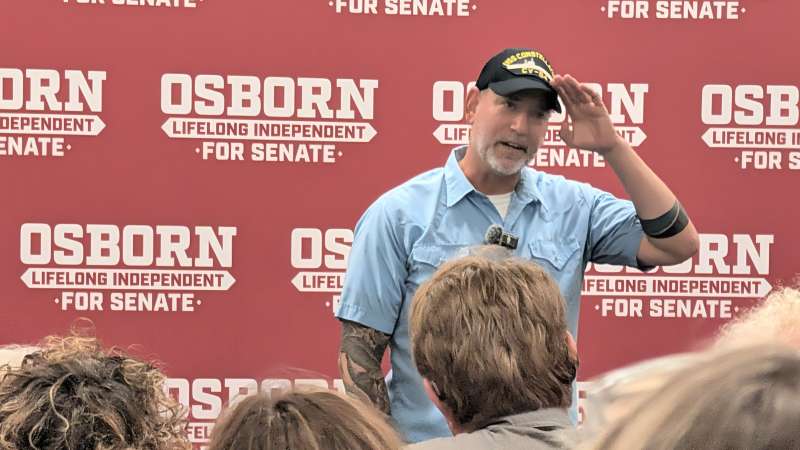
Dan Osborn, Independent candidate for US Senate in Nebraska, wants the artificial intelligence (AI) industry to work for Nebraskans—not the other way around.
The former union leader from Omaha turned Senate hopeful, alongside a small but growing list of candidates across the county, has committed to the position by signing onto The AI Pact.
The public agreement campaign is organized by the Political Integrity Project, an independent, nonpartisan watchdog group focused on tracking the money in US politics. Osborn is the only candidate seeking office in Nebraska this November to receive a passing grade from the group—and the only Nebraska candidate to sign The AI Pact to date.
The pact makes candidates pledge to support five distinct pillars regarding regulations on AI and data center development. These include banning tax breaks for data centers, mandating independent safety reviews, prioritizing privacy rights, and supporting policies that share AI’s gains with the workers it displaces.
The topic has exploded into prominence in Nebraska this year, as a growing number of communities in the state have considered, or enacted, moratoriums on data center projects. As a reaction, Gov. Jim Pillen recently launched a data center task force to assist with drafting rules and regulations on data centers. The task force has been criticized for its composition of primarily industry-connected individuals and the appearance of a conflict of interest with numerous members.
Osborn has been outspoken about his concerns on AI and data centers this year as he campaigns to unseat former governor, now US Senator Pete Ricketts. The incumbent Republican and multi-millionaire has frequently characterized AI development in the US as a “national security issue” and vital in a perceived “AI race” against China.
During his final year as governor, Ricketts also signed legislation to exempt sales tax on certain purchases made by large data centers.
Earlier this month, Osborn told C-SPAN that a blanket moratorium on data centers “could be a mistake,” saying he doesn’t want the US to “lose out” to China. He added, however, that he’d like to see a moratorium on Flock cameras.
Speaking with Courier Nebraska in July, Osborn expressed that, in his view, data center regulations ought to be primarily regulated by the federal government, not state and municipal officials. Osborn said he understands “taking a step back” to evaluate the impacts of these massive industrial developments.
“The federal government should be doing things to place guardrails on these data centers, making sure they’re transparent about power usage and water usage,” said Osborn. “They need to be held accountable for any negative effects on the environment.”
Given Nebraska’s one-of-a-kind public power system, Osborn added “I don’t think anybody’s power bill should go up a cent for these data centers.”
Osborn’s nuance on the subject is consistent with those expressed by labor union circles, the organizing background which birthed Osborn’s candidacy.
Speaking before the Cass County board of commissioners in August, Mike Gage, president of the Nebraska state AFL-CIO, offered neutral testimony on a moratorium recommendation, advocating for a community benefit agreement while adding that he didn’t want Cass County to miss an “opportunity for development.” The board ultimately voted unanimously to approve the moratorium.
Osborn frequently discusses the subject and addresses resident concerns in the state’s rural communities, a part of his campaign’s 93-county tour.
Voters will decide if Ricketts will continue to represent Nebraska in the US Senate for another six years, or whether to swap in Osborn, on Nov. 3.