On Wednesday, Aug. 19, Gov. Jim Pillen announced his appointment of 17 members to the newly created Nebraska Data Center Task Force.
This force spins out of Pillen’s recent executive order (EO 26-17), which disqualifies new data center projects coming to Nebraska from receiving tax incentives provided under a specific program named the ImagiNE Act. According to numbers obtained by 10/11 NOW, data center projects in Nebraska have benefited from $519 million in estimated property tax breaks since the program began in 2021.
The 17-member board will report to the state’s Department of Water, Environment and Energy (DWEE), tasked with helping “evaluate the impact of data centers on Nebraska’s water resources, power grids, and local infrastructure.” They’ll also help ensure that county officials “have the necessary tools, zoning guidelines, and policy frameworks to manage data center growth effectively.”
“The members of this group bring the knowledge of each of their respective industries,” Pillen said of the board in a statement. “Together, they will ensure that we are making solid decisions when it comes to balancing data center development with the continued preservation of our land, electricity and water.”
It is anticipated that the task force will have its first meeting in September 2026.
Following the announcement of his task force appointments, Pillen opened his Aug. 21 column: “Nebraska is open for business!”
This article compiles relevant information on each task force member, and their business/political affiliations, in regards to data center development.
Nebraska Data Center Task Force
1. Mark Hewett – Berkshire Hathaway Energy
Hewett serves as president, CEO, and director of Berkshire Hathaway Energy (BHE)—an energy holding company based in Des Moines, Iowa. It is wholly a subsidiary of Berkshire Hathaway, following a 2024 acquisition. BHE controls a ranging portfolio of utility and energy businesses, supplying electricity and natural gas to more than 5 million customers across the US, UK, and Canada.
Berkshire Hathaway, the multinational conglomerate holding company headquartered in Omaha, formerly led by Warren Buffett, has notable investments in big-tech companies like Apple and Alphabet, the parent company of Google—which operates two data centers in Nebraska with one more being built in Lincoln. The trillion dollar company also owns an aerospace manufacturing company benefiting from increased demand from AI companies for gas-powered turbines.
BHE reported “unprecedented load growth” requests from technology firms in 2025, and announced capital expenditure plans of $33.3 billion over the 2026-2028 period to meet the infrastructure needs for AI data center build-out.
Greg Abel, the current CEO of Berkshire Hathaway, has stated his preference that AI data centers (sometimes called “hyperscalers”) bear the full cost of their immense energy demands without shifting rate burdens onto utility customers.
2. Chris Leitner – Tenaska
Leitner serves as the president and CEO of Tenaska—an Omaha-based private energy company founded in 1987 and ranked last year the 50th largest private company in the US.
Earlier this year, Flatwater Free Press reported that Tenaska was partnering with Google to build a 2,000-acre natural gas power plant and data center in southeast Nebraska.
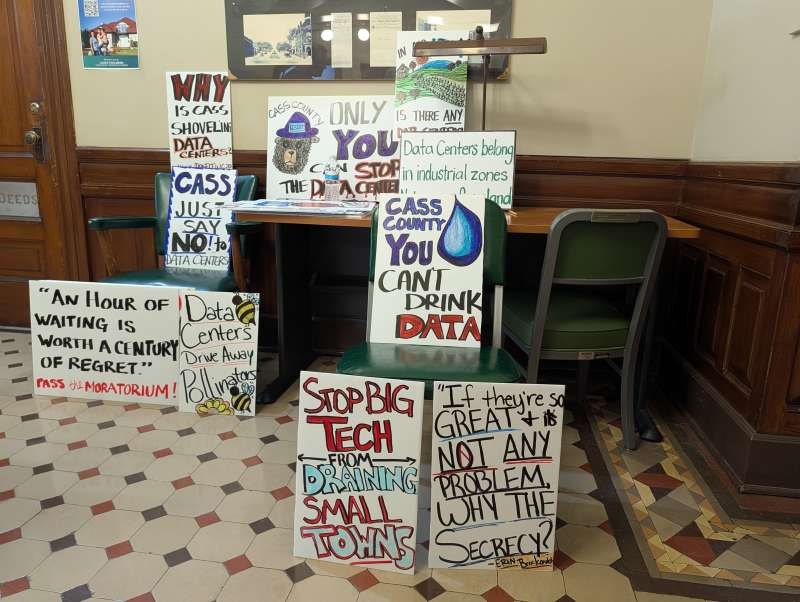
As reported by WOWT, the company optioned 1,354 acres in Cass County along Highway 75 south of Murray and Beaver Lake in June. Following widely oppositional community input, the Cass County board of commissioners unanimously approved a 12-month moratorium on data center projects.
The company is also behind proposals in Gage and Otoe counties, the latter of which passed a one-year moratorium, while the former is set to consider the idea in early September.
Tenaska manages a power-generation fleet capacity of 6,622 megawatts in natural gas, wind and solar across 16 facilities in 8 states.
According to campaign finance disclosures, Tenaska made a total of seven direct contributions to Jim Pillen since July 5, 2022, totaling $110,000 after the company’s most recent donation of $50,000 on December 30, 2025. Pillen’s campaign also received a $50,000 campaign contribution from “Google LLC and its Affiliates” on July 2, 2026.
3. David Miles – Kiewit Infrastructure Group
Miles serves as president of Kiewit Infrastructure Group—one of the largest construction and engineering companies in the county, headquartered in downtown Omaha. The company employs over 34,000 people globally and recorded $18.2 billion in revenue in 2025.
Kiewit has a long history of government contract work, both federally and in Nebraska. Locally, the firm notably served as the construction manager for Omaha’s $325 million RiverFront redevelopment project, collaborated with the Omaha Public Power District to build new natural gas generation units, and built its $115 million namesake Kiewit Hall for the College of Engineering on the University of Nebraska-Lincoln city campus.
Vicki Kramer, current Director of the Nebraska Department of Transportation (NDOT), worked for Kiewit before her current role in Pillen’s administration.
Between September 2022 and December 2025, the Kiewit Corporation made four direct campaign contributions to the Pillen for Governor campaign, totalling $55,000.
Kiewit is a major data center contractor, currently in the process of transforming a retired Pennsylvania power plant into a 3,200-acre natural gas-powered data center campus.
4. Mike Miller – HDR
Miller serves as the broadband group leader at HDR—an Omaha-based design and engineering firm that boasts over 15,000 employees across 200 locations in 15 operating countries.
According to the architecture news outlet BD+C, HDR is the second-largest data center engineering firm in the country, generating an estimated $177,521,000 in revenue from data center facilities in 2024.
In 2022, Nebraska passed legislation opening the door to more private-sector involvement in public transportation projects. NDOT then brought in HDR to help update the state’s guidelines for how those projects should move forward. HDR was also selected this year by the University of Nebraska Board of Regents to serve as one of the lead architects of record for NU’s massive $600 million renovation plan for Memorial Stadium.
Campaign finance databases show an “HDR Inc Employee Owner” donated directly to Pillen, a former NU Regent, twice in 2022, totalling $7,500.
In 2021, HDR faced public backlash and eventually a federal lawsuit for using a proprietary surveillance program—dubbed STRATA—to monitor online activist groups opposing their ongoing infrastructure and jail-building projects at the time
5. Tony Cotton
Cotton is a retired United States Air Force four-star general who last served as the 12th commander of the United States Strategic Command at Offutt Air Force Base in Bellevue.
He is a board member of HDR.
6. Javier Fernandez – OPPD
Fernandez serves as the president and CEO of the Omaha Public Power District (OPPD)—the public, nonprofit electric utility that provides electricity to about 893,000 people. The eight-member, officially nonpartisan board of directors are elected to represent Omaha and 13 surrounding counties for six-year terms. Fernandez has held the role since 2021 and first joined OPPD in 2017.
Fernandez also serves as the president of the Nebraska Power Association Board and is an active board member for Ameritas, a mutual-based financial services and insurance company headquartered in Lincoln. Ameritas’ wealth management arm holds stock in companies that power data center infrastructure—such as Monolithic Power Systems and NVIDIA.
As reported by Nebraska Public Media, data centers consumed 1% of the electricity sold by OPPD in 2018. In 2024, data centers used 21%. By 2035, data centers are projected to account for 41% of OPPD’s electricity sales.
For the first time in over two decades, OPPD commissioned two new power plants in September 2025. Fernandez told WOWT that data centers and AI, among general manufacturing sector growth, were key drivers for construction.
7. Tom Kent – NPPD
Kent serves as the president and CEO of the Nebraska Public Power District (NPPD)— the state’s largest publicly-owned electric utility, serving over 500,000 people in 84 out of Nebraska’s 93 counties. It’s governed by an 11-member board of directors, on which members are elected to serve six-year terms. Kent first joined NPPD in 1990 and was appointed to lead the district by the board in 2020.
NPPD’s website says Nebraska is an “ideal for energy-intensive data centers,” citing the state’s central location, reliable power grid, strong fiber network, relatively low risk of major natural disasters, business-friendly tax incentives, and access to renewable energy.
Kent told PublicPower.org that data centers are drawn to Nebraska because “public power is generally thought of as easier to work with and can be more responsive because we often have less regulatory hurdles,” while also acknowledging resident concerns about water quality and electric rates.
Earlier this month, it was announced that NPPD and OPPD would be among the founding members of the SAFERai.power initiative, a risk-mitigation effort launched by the Electric Power Research Institute—a nonprofit research firm for the electricity industry that Kent serves as a board member for.
8. Emeka Anyanwu – LES
Anyanwu serves as the CEO of the Lincoln Electric System (LES)—a publicly owned, nonprofit electric utility that provides electricity to about 275,000 people in Lincoln and the surrounding area. The nine members of the utility’s board are appointed by the mayor and confirmed by the city council of Lincoln. Anyanwu was approved for the role and began at the start of 2024.
In 2023, Google announced its plans to build its third data center in Nebraska, which ended up settling near northeast Lincoln on N. 56th and I-80 where it remains under construction.
In September 2025, LES received $300,000 from Google to expand energy-efficiency upgrades for affordable housing in Lincoln, with funding aimed at rental units in a city rehabilitation program.
Anyanwu also serves on the board of directors for the Lincoln Chamber of Commerce, which celebrated Google’s data center announcement. While testifying on a bill pertaining to large-scale electric users in 2026 before the legislature’s Natural Resources Committee, Anyanwu told lawmakers that LES maintains a good relationship with Google and Meta.
9. Rick Nelson – Nebraska Rural Electric Association
Nelson serves as the general manager of the Nebraska Rural Electric Association (NREA)—a private, nonprofit trade association and lobbying group that represents 35 rural electric systems operating over 97,000 miles of electrical line across the state. Nelson was named general manager by the organization’s executive committee in 2022. He also led the Custer Public Power District until late 2025.
In a December 2025 column, Nelson argued that Nebraska’s current debate over data centers and other large new electric loads echoes an earlier era when deep-well irrigation raised similar fears about power shortages and rising costs. He suggested that the state successfully adapted then, and can do the same now.
NREA is a member of the National Rural Electric Cooperative Association, a trade organization expressly in favor of environmental policies that “rely on incentives and encourage voluntary conservation efforts.”
A note on public power
Nebraska is the only state in the nation where 100% of retail electric utility services are provided by publicly owned entities, like the power districts listed above. Because these entities are owned by the community, rather than outside stockholders, they operate on a nonprofit, cost-of-service basis.
In 2026, state lawmakers debated and ultimately passed legislation—LB 1261—which creates a pathway for very large industrial customers, like data centers, to bring or develop private power generation while still operating within Nebraska’s public power system.
The bill, introduced at Gov. Pillen’s request, generally prohibits public power utilities from exercising eminent domain to acquire privately owned electric generation facilities if they meet certain conditions:
- The facility must serve a single-user entity with a new electric load exceeding 1,000 megawatts at a single site.
- They must be physically located on, or adjacent to, that large industrial customer.
- Projects are subject to formal approval from the Nebraska Power Review Board.
- Parties must execute a long-term contract with the local public power district, and the facility can only be used to serve that specific industrial partner.
The industrial customer must pay for all costs, grid upgrade fees, and congestion charges resulting from their project.
The private-energy carveout outlined in the bill applies to state contracts through Dec. 31, 2031.
When the bill came before the legislature’s Natural Resources committee, representatives for NPPD, OPPD, LES, NREA, and Tenaska testified in support of the measure. Gov. Pillen celebrated the bill’s signing in early June.
10. Micaela Wuehler – Lincoln County
Wuehler serves as the District 3 representative on the Lincoln County Board of Commissioners—which consists of five members.
The Lincoln County board has assumed center stage in Nebraska’s evolving relationship with data center projects, as a recall effort was launched against three of the board’s commissioners in July following a controversial 2-3 vote on a data center moratorium.
The recall targets those commissioners who voted no:
- Joe Hewgley – District 1
- Chris Bruns – District 4
- Jerry Woodruff – District 5
In late July, Wuehler said data centers have become a major issue for county officials nationwide, not just in Nebraska. After attending a National Association of Counties conference in New Orleans, she said sessions on data centers drew heavy interest from officials comparing notes on land use, infrastructure, and community impacts. Wuehler said she brought back best-practice materials and plans to compare them with Nebraska’s land-use “toolbox” to see what local officials may need to add or adjust.
After Courier Nebraska detailed some affiliations of members of the Nebraska data center task force, Wuehler replied, saying she’d “fill the void” and “be that member asking the tough questions and working to ensure the recommendations are protective to our people, land, water, wildlife and Nebraska way of life.”
11. Angi Burmeister – Sarpy County
Burmeister serves as the District 3 representative on the Sarpy County Board of Commissioners—which consists of five members.
Social media giant Meta, the parent company of Facebook and Instagram, operates one of its largest data centers in the county, near Papillion. The facility spans 4 million square feet across nine planned or completed buildings and went live in 2019. Sarpy is also home to a Google-owned data center.
Reacting to her appointment to the Nebraska data center task force, Burmeister said on social media: “Good decisions require details. Looking forward to hearing from the great group of individuals I get the opportunity to serve with on their insight in their areas of expertise.”
Meta’s data center in Sarpy County is not located within her district, but rather District 5.
12. Heath Mello – Greater Omaha Chamber
Mello is the current president and CEO of the Greater Omaha Chamber (GOC) of Commerce—the main business federation of the state’s biggest city. He was named to the role in 2023. Mello also served as a state senator from 2009 to 2017.
GOC and Mello have been openly supportive of data center development in the area. In 2025, GOC announced a partnership with Scott Data to position Omaha as a leading AI hub in the Midwest. The effort is meant to help local businesses adopt AI, attract tech-focused companies, and give small and mid-sized firms access to infrastructure and services from Scott Data—a nonprofit data center on the University of Nebraska – Omaha campus.
“This partnership is a bold step forward in making Omaha the premier destination in the Midwest and the country for AI innovation and adoption,” said Mello.
In an op-ed penned by Mello in July 2026, he argued that data center development in Nebraska should be viewed not just as a local land-use issue, but as part of the broader US-China race for artificial intelligence dominance. The author says Nebraska has major advantages for data centers but warns that local permitting fights and zoning delays could slow American AI growth while China accelerates.
13. Kevin Stocker – Nebraska Public Service Commission
Stocker serves as the District 5 commissioner on the Nebraska Public Service Commission. He was elected in November 2022.
As detailed in a recent report from the Energy and Policy Institute, Stocker is connected to the Regulators Roundtable—a subgroup of the Republican organization GOPAC—which functions as a “secretive” influence and policy network connecting conservative utility commissioners with corporate industry “investors” and the federal administration.
The report also contains public record documents that show GOPAC affiliates drafting a pro-coal, anti-renewable op-ed for Stocker in April 2025. A nearly identical version was later published under Stocker’s name.
GOPAC launched the Regulators Roundtable in January 2025. Roundtable president and GOPAC board director Elizabeth Gianini described one of the roundtable’s objectives as countering “liberal organizations” that were “advocating against conservative commissioners.” A 2025 member newsletter similarly said the Roundtable exists to equip conservative commissioners with the knowledge to “push back” on “liberal environmental groups pushing a 100% green energy agenda.”
Following the announcement of his appointment, Stocker said in a social media comment section that his goal on the force is to “gather factual information, ask tough questions, and ensure decisions are guided by reliable data—not speculation, fear, or political agendas.”
“As always, I will seek the opinions of my fellow Nebraskans. Your concerns, experiences, and perspectives deserve to be part of this important conversation,” Stocker said.
14. Ron Kaminski
Kaminski is the vice chair of the Nebraska Democratic Party and the president of the Nebraska & Southwest Iowa Building & Construction Trades Council—the local affiliate of North America’s Building Trades Unions. The organization represents over about 3,000 signatory contractors and over 25,000 union construction workers across the region.
In June, Kaminski spoke before the city council of Council Bluffs, Iowa, in opposition to a local moratorium on data center projects, saying projects of the like can create thousands of jobs in the region.
While the Cass County Board of Commissioners considered, and ultimately approved, a 12-month data center moratorium earlier this month, Kaminski offered neutral testimony saying “We can meet somewhere in the middle.”
Kaminski cited work with lawmakers, environmentalists, and labor groups “to ensure we have disclosure in water and electrical usage, that burdens are not shifted to residents, that companies pay their fair share of taxes and draft decommissioning plans, and a process to enter into a community benefit agreement.”
15. John Winkler – Papio NRD
Winker serves as the general manager of the Papio Natural Resources District (NRD)—which covers six southeast Nebraska counties, including all of Douglas, Sarpy, Washington, and Dakota counties and portions of Burt and Thurston counties.
According to his LinkedIn profile, Winkler works as an analyst for Catalyst Public Affairs. He’s also the registered agent for the public affairs consulting firm “The Win Group”—a lobbying organization that advocates for data center companies and projects.
16. David Eigenberg – Upper Big Blue NRD
Eigenberg (misspelled “Eichenberg” in Pillen’s announcement) serves as the general manager of the Upper Big Blue Natural Resources District (NRD)—which covers nine counties in south-central and southeastern Nebraska: Adams, Butler, Clay, Fillmore, Hamilton, Polk, Saline, Seward, and York.
Eigenberg was appointed to the role in 2016. He announced this summer he will retire in December 2026.
17. Doug Whitfield – Metropolitan Utilities District
Whitfield serves as the vice president of water operations for the Metropolitan Utilities District (MUD)—a public utility providing drinking water and natural gas to over 600,000 people in the greater Omaha area. MUD is governed by an elected seven-member board of directors.
Before his current role, Whitfield worked as the director of MUD’s Platte South Water Treatment Plant. The utility operates three water treatment plants in total.
Speaking on data centers with the Midlands Business Journal in April, Whitfield emphasized that the utility is prepared to support future growth, saying its systems, facilities, and workforce has put the region in a strong position for continued development.